Showing posts with label TAZ. Show all posts

Thursday, January 7, 2016

FREEPARTY-CLOPEDIA ADDENDUM

A little addition to the FREEPARTY-CLOPEDIA that was handed out during the NYE multisound in Belgium last weekend. Our goal was to make people more aware about their own trash and actions when they wander the building being used for a TAZ.


Tuesday, September 3, 2013

SPACE PIKNIK 2013

The summer of 2013 was awesome! Thanks to a great trip to Czech Republic and Slovakia and an unforgettable collaboration between our friends Kierewiet (NL), Exit23 (BE) and us [013] (BE). When I find the time I will document this trip in a post with pictures and videos. But for now enjoy this overview video of Space Piknik 2013 in CZ. The first illegal teknival in CZ since 2005!


Monday, April 1, 2013

COUNTER-ECONOMICS AND THE COUNTERCULTURE

Few weeks ago I discovered a blog called Propaganda Lalaland when I stumbled upon the article "Anarchists Want To Force You Into Anarchism!". Satisfied by a good short read I bookmarked it in my unsorted, personal nightmare, list of pages I should keep track off. Should.. I gave up on RSS because it feeds me with too much information I want to read, yet can't due to lack of time or just can't make up my mind and end up doodling something random on basically anything. Rediscovered my love for just drawing whatever whenever, so I bought myself a shitload of pencils, erasers and sharpies. Staring at my collection while writing this I noticed that alot of sharpies are missing. Note to self, stop ruining them on walls and other hard/rough materials. My list of casualties peaked this month and I am basically throwing money away :D Anyway.. in other news, the writer of  Propaganda Lalaland posted a new article this weekend and here I am telling you about it. Going for at least one person to sit trough my rant and actually click the URL below! Don't let me down.

My sunday, drove home when I was sober-ish.. spent hours starting several projects in Illustrator (of wish some I might finish this week, that would be great actually with our trip to the east of Česká republika coming up in 3 weeks. Kicking off the teknival season/summer! Taking our own sound with us, collaborating with our friends and fellow astronauts from Kierewiet creating a bigger and better experience for those who are coming. Hopefully Gagamous Kierewiet finally finds his way back home, since he is missing in action since mid February 2013 after hosting a night in Ostrava. So whoever took him, here is your chance to regain your dignity and make that trip to Klokočov. Man up (this includes women) and reunite Gagamous with his family.

M.I.A. since 02/2013 - last seen in Ostrava, CZ

Those who are just clicking trough and go straight for the link.
Click here "Counter-Economics and the Counterculture".
Everything above is barely related anyway..
so don't bother and start reading that article :D

Follow Propaganda Lalaland here.
Find out more about agorism at.. agorism.info.
.INFO shout out, because information is awesome :D
Also providing information is zoneofthefree.info.

Saturday, July 21, 2012

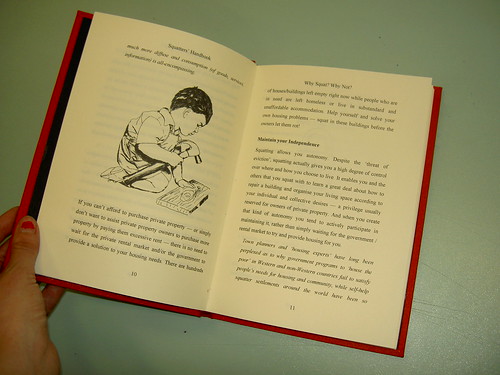
SQUADSPACE SQUATTERS' HANDBOOK

SquatSpace is an Australian collective of artists and activists.
Want to know more?
The Squatters' Handbook is a resource for homeless people. It provides practical and legal information required by those seeking to find housing for themselves in abandoned buildings. The book does not seek to incite "illegal" activities (trespass is a criminal offence in NSW) but to provide essential information to people who might need it. Squatting has always been a tactic for finding housing in urban areas, all around the world. With the burgeoning real-estate investment market in Sydney, rental properties for low-income earners have become unaffordable in the last ten years. At the same time, the waiting list for public housing grows longer, while the state government sells off its available housing stock to developers. The Squatters' Handbook merely provides information to those already inclined to seek their own solutions in this unfriendly social environment.


Squatters' Handbook Chapter 1

Why Squat? Why Not?
Are you being squeezed out by ridiculously high rents and the gentrification of cities? Tired of waiting for disinterested governments to come to your assistance? Fed up with sleeping in parks/bus shelters/friends’ lounge room floors? Want to create and control your own living space? Take matters into your own hands — Go squat! There have been squatters for as long as the concept of owning land has existed: squatting on land that legally belongs to someone else takes place all over the world. There are probably as many reasons for squatting as there are people who squat — here are just a few of the things that motivate them.

Unaffordable rents
Despite government policies aimed at promoting ‘affordable’ housing, it’s clear that the number of low-income people able to afford housing is rapidly decreasing. The cost of private rental accommodation is increasing exponentially, pushing many low-income earners away from the areas in which they and their friends live. The private rental market is largely deregulated and tenancy laws afford low-income earners little protection from the increasingly exorbitant rents demanded by landowners and their real estate agents. It’s profit margins that count. Look at the scale of urban gentrification in Sydney at the moment — it doesn’t look like abating in the near future does it? Relax. It’s only natural — the strong over the weak. One day, when you can afford to purchase property of your own, you will understand. You too will give the gift of rental accommodation to someone who has enough money to afford it but not enough to return the gift. And they will give you the security you need for further speculation in real estate. Everyone’s a winner!

Why Wait Endlessly for Handouts?
Public housing once may have been an alternative. But with waiting lists as long as they are, and with waiting time of up to 12 years, government housing is not really a viable option for many. As governments become visibly less interested in housing low-income people — by selling Department of Housing land to private developers, cutting back on spending for new housing, outsourcing their role to private contractors in ‘community housing’ — it becomes more blatantly obvious that to rely on their goodwill to satisfy your housing needs and wants is a ploddingly dangerous mistake. People used to squat government-owned buildings before any others because it was thought there was more room to negotiate with ‘public’ authorities with a ‘conscience’, than with ‘private’ property speculators and companies who were more obviously concerned with ‘making money’. Now there are no doubts that such a comforting distinction cannot be maintained. What is ‘public’ space and what is ‘private’ space? They seem to have melded and colluded some time ago, and if they are keeping any secret it is this: welcome to a world without clear borders where power is much more diffuse and consumption (of goods, services, information) is all-encompassing.

If you can’t afford to purchase private property — or simply don’t want to assist private property owners to purchase more property by paying them excessive rent — there is no need to wait for the private rental market and/or the government to provide a solution to your housing needs. There are hundreds of houses/buildings left empty right now while people who are in need are left homeless or live in substandard and unaffordable accommodation. Help yourself and solve your own housing problems — squat in these buildings before the owners let them rot!

Maintain your Independence
Squatting allows you autonomy. Despite the ‘threat of eviction’, squatting actually gives you a high degree of control over where and how you choose to live. It enables you and the others that you squat with to learn a great deal about how to repair a building and organise your living space according to your individual and collective desires — a privilege usually reserved for owners of private property. And when you create that kind of autonomy you tend to actively participate in maintaining it, rather than simply waiting for the government / rental market to try and provide housing for you.

Town planners and ‘housing experts’ have long been perplexed as to why government programs to ‘house the poor’ in Western and non-Western countries fail to satisfy people’s needs for housing and community, while self-help squatter settlements around the world have been so successful. The answer lies in the autonomy that squatters create and maintain for themselves by taking control of their own housing problems.


Continue reading here

Friday, July 13, 2012

HAKIM BEY WITH 69DB AND OTHERS

Hakim Bey, painted portrait DDC_3021


Hakim Bey Talks with users of Public Netbase
March 18.1995

Excerpt from the transcript. May I advice you to read the full transcript.

SEB:
On that point for me it's interesting living in a communal group. The way that suddenly you realize that the whole process of what you are doing is in fact an ego game, that you are working out amongst all the other people involved - we all come from western society.
It took me psychedelics to wake up to be honest. And it took me being in a situation whereby Brittain had an underground movement which lasted for four years solid. And this movement was a Free Party movement. This was coming together thousands of people and all dancing underneath the stars for sometimes periods of two weeks. This were serious nights of partying. This brought us to the edge where we suddenly realized where our freedom lay.
Everyone thinks we are free, we were told that - and I believed it all the way - but suddenly when you push out and find out that by expressing your freedom you got riot police coming in and beating people up, suddenly you find out that your freedom doesn't stretch so far.
There is this issue in Britain of Commonland. I remember when we were in Leeds we were looking for a place to do a party. The traditional place in Britain is Commonland. I went to Leeds to have a look at the maps of Commonland, and all the land that was given to the people, there were only two pieces left. I checked both places. First was a field for a farmers corn and the second place was an airport... This is land that was given to the people for specific parties and festivals, put it's not there anymore, it's been sold off.

X:
This shows us that in the end you need physical space. If you want Immediatism, you want physical space.

XX:
Maybe we should go to virtual space.

X to H. BEY :
But this is a contradiction to immediacy, cause immediacy claims that you shouldn't use the media to come together but you use physical space. And in the end this is inconsistent.

H. BEY :
This is not exactly what I've said. What I said was that there is no Temporary Autonomous Zone without physical space. I didn't say that there is no interrelationship between cyberspace and physical space. Of course there's a relationship - there are many different kinds of relations. But what I'm talking about, how I'm defining freedom for the time being, if it doesn't include the body it is an illusion. If my eyes are free but my nose isn't, so this is not what I call freedom. I say there is no festival inside cyberspace. If it doesn't interpenetrate with the physical world, then it's simply another form of representation. Everything which was once lived, has now moved away into representation. And if this is felt to be a form of un-freedom, than it is precisely representation which we find ourselves in a struggle against.
In this sense it may be necessary to ultimately take up a very hostile stand toward cyberspace, or we may find it is a useful weapon, but we will not find our freedom in a machine. We won't find our freedom as a representation in a machine. I can turn myself into a cartoon figure going to virtual reality and act all kinds of fantasies but that won't be live, that would be representation. A representation of myself to the space and a representation of the space to myself. In that circularity there is no exit - there is no escape from that kind of viscous circle. So that's why I don't say that there's some dichotomy between the physical and the non physical but the one without the other is not freedom. You see what I'm saying?

XX:
No that's not true! Because you can leave this material world. It's not so easy but it's possible - you can go into immaterial, antimaterial world.

XXX:
For me that's an interesting point. All live is representational anyway, we are living in a type of illusion or cyberspace reality where we have these meat machines to walk around. Cyberspace doesn't exist yet. In the moment the closest space that we have to cyberspace is innerspace, where creativity - perhaps - ultimately comes from.

H. BEY :
Well, we all know, that there is no absolute direct experience - that the body itself is a medium, that proprioception is mediated by the nervous system etc. etc. But I still maintain that it is possible to construct a hierarchy of values in which certain things are more and certain things are less embodied. To simply take some kind of Berkleyan idealism, which is what I'm getting from you - to say that the body has no reality and therefore there is no difference between virtual reality, whether it be virtual or actual virtual reality, is something that I have to reject.
I don't see this lack of distinction. I know that there is a great platonic, mystical, gnostic dualist tradition, which you guys seem to be here today to represent, which really does believe, that we are going to leave our body, that there's some real eternal entity inside the body, which is going to escape and is going to heaven when you die. I don't know this shit and frankly I don't believe it - it's finished - I might as well go become a Christian.

XX:
I can show you this concept mathematically - you can proof it. Matter, antimatter - other forms of energy. The last human chess master - if the computer is better in chess than the best human chess master the same can happen to literature and music.

H. BEY :
First of all I've never met anybody from the antimatter world. So I don't have any opinion about the existence of consciousness within the world of antimatter.
Second chess can be reduced to mathematics, we know that this is true, but we don't know that literature or life or flesh can be reduced to mathematics. That has not been shown to my satisfaction and if it's shown to yours I would appreciate some references.

SEB:
On this issue, for me, you would help me if you would clarify the difference between meditation, the psychedelic experience, the trance dance, what happens at rave parties. I think on these lines as a backup to what I'm doing with the techno side and also looking at creativity and the idea of clearing the ego from the process and allowing pure source energy through. What is the difference?

H. BEY :
Possibly we're talking about different states of consciousness. My inclination is to think everything is real, which of course means reality becomes a very fuzzy concept. But I have experience of the world of the imagination too. It's on the level that one experiences it. It's of course very very real. It can change your life and through it you can change the world. So the imagination is clearly something which is as real, in this sense, as anything else. Virtual reality is as real, in this sense, as anything else. But I would go back to the idea of a practical hierarchy, which has to be ultimately, subjectively based. Is it doing it for me, or is it not?
On the bases of the only possible values, that we can create for ourselves - this kind of gradation of media, by which I mean language, body, everything, can arrange in some kind of a useful program for oneself, where certain spaces are more liberated. Certain modes of consciousness are more joyful. That's really the best I can say. .

SEB:
What about the idea of improvisation, the whole idea of reflecting the moment. How that is necessary to the development of the consciousness, it does seem to have the ability to pull the mind in and take it somewhere. This whole process is very important for culture and has been obliterated in the west for the past few hundred years but does seem to emerge through the subcultures and always has done.

H. BEY :
I think improvisation is a good key to this. If you can develope a kind of Zen-approach to this levels, so you need not use a hard and fast religion, ideology or philosophy to prejudge the utility of one level over the other that would be the appropriate modus operandi. The best way to go would be what I call a psychic martial artist.


Read the full transcript here: http://hermetic.com/bey/hb18-3pu.html

Thursday, May 31, 2012

HAKIM BEY: REPOPULATING THE TEMPORARY AUTONOMOUS ZONE

Hakim Bey: Repopulating the Temporary Autonomous Zone
Author: Simon Sellars


From: Journal for the Study of Radicalism
Volume 4, Number 2, Fall 2010
pp. 83-108 | 10.1353/jsr.2010.0007

In lieu of an abstract, here is a brief excerpt of the content:

Project MUSE - Journal for the Study of Radicalism - Hakim Bey: Repopulating the Temporary Autonomous Zone Browse > History > Journal for the Study of Radicalism > Volume 4, Number 2, Fall 2010 Download PDF Hakim Bey:Repopulating the Temporary Autonomous Zone Simon SellarsRMIT University, Melbourne, Australia The poet and essayist Peter Lamborn Wilson is widely known for his anarchist manifesto "The Temporary Autonomous Zone" (TAZ), developed across a series of essays written from 1981 to 1988 and published in collected form in 1991 as T.A.Z.: The Temporary Autonomous Zone, Ontological Anarchy, Poetic Terrorism. The essays were attributed to "Hakim Bey," Wilson's infamous pseudonym, and the writing itself was a potent brew of mysticism, historical narratives, autonomous Marxist politics, and French critical theory. The overall aim was to highlight indeterminate zones within late capitalism, everyday occurrences that refuse, whether by accident or design, to be incorporated into dominant narratives. This enabled The TAZ to become an extraordinarily influential (and divisive) text in anarchist circles, and in various pop cultural movements. But has that moment passed? Can the concept hold any meaning for observers in the early twenty-first century? This essay will argue that, although the cultural capital of the TAZ has undoubtedly become degraded through overuse, the circumstances of its cultural reception are indeed worth returning to and remembering. Repopulating the TAZ can reward us now (as it did at inception) with valuable insight into the perceived role of critically engaged literature and philosophy as an activator of political potential, illumining a debate regarding the supposed (in)compatibility of leftist theory and politics that continues today. The TAZ and cyberculture: "Life in the trenches" The TAZ may have remained a fringe work if it wasn't for cyberculture, where it proved to be among the more resilient memes in alternative art and culture from the mid-1980s to the mid-1990s. The original electronic networks that became the prototype for today's commercial Internet were developed in the 1980s, a development of the first interconnected computer channels produced in the 1960s for U.S. military purposes. As François Cusset summarizes: "These networks embodied, for some, a space for resistance, a social dead zone, a territory that was still imperceptible, in whose shelter they could build a new community and undermine the ruling powers . . . the first groups of hackers emerged [and formed,] in Bruce Sterling's words, a veritable 'digital underground.'" In cyberculture's incandescent popcult moment, the gritty noir futures of cyberpunk science fiction, built upon the template forged by the ascending reputations of novelists William Gibson and Sterling, and extrapolated from present-day technological developments, were cited as metaphoric portrayals of a real world in thrall to the nascent Internet and to the implications for mediated life it held. Cyberphile magazines like Mondo 2000 (and later, Wired and 21C) spliced cyberpunk attitude with digital culture's bleeding edge, carrying advertisements for dial-up modems, cd-roms, and pixel art software in between articles and interviews exploring every facet of cyberculture: from body modification to the emergent politics of the net, from new strains of cyberpunk fiction and rave music to the "bumper sticker libertarianism" leaking from cyberculture's startling new cachet. Fermented within this heady "frontier" atmosphere, manifestos were abundant. John Perry Barlow of the Electronic Frontier Foundation drew up "A Declaration for the Independence of Cyberspace," demanding that the net—"the new home of Mind"—be forever self-governing, forever free from corporate and governmental restriction. Douglas Rushkoff produced a book-length vérité document of "life in the trenches of cyberspace" (or "Cyberia"), where "cyberians" "believe the age upon...


Wednesday, May 23, 2012

ZONING OUT (TEMPORARILY)

Zoning Out, Temporarily with Hakim Bey and Genesis P-Orridgeby John Perry Barlow, Mondo 2000 No. 9 1993


It was Queen Mu who made this happen - her conspiratorial whisper suggesting that I get myself together with Hakim Bey, Genesis P-Orridge, and a MONDO tape recorder. I wasn't too sure what she had in mind.

I mean, aside from the fact that all three of us are white, male acid-altered, old enough to know better, and crazy enough to do it anyway... Our resumes just didn't hook up and I wondered if we would.

Mr. Orridge, for example, is one singular fellow. He's got hardware dangling all over a body which sports more ritual scars and tattoos than Melville's Queequeg (with whom he shares other characteristics, most notably a nightmarish appearance cloaking a sweet and reasonable mind). He also happens to be the father of modern primitivism, the post-industrial tribes, the Rave Movement, the avant-garde band Psychic TV, and a couple of beautiful young daughters.

Orridge has been willfully causing such grave offense to British proprietary for the last twenty years that they've finally seen no alternative but to seize all his works and archives and pass laws which, though tailored to outlaw him, also make it a crime to give any other British subject so much as a hickey. (Or cause any physical harm to oneself or another consenting adult in the pursuit of dark pleasures.)

Finally, agents of the Crown have sent him packing into exile in California - a place so much more congenial to abominations that Mr. Orridge is having to scratch around for something to sink his sharpened teeth into.

Hakim Bey is another whose deviances have forced him to hide behind another name. Spending much of his life disguised as a mild-mannered comparative religion scholar, he emerges in print as an anarcho-gay drug fiend and Sufi pirate, compared to whom Salmon Rushdie is as orthodox as an ayatollah. Hakim's the guy who put the Temporary Autonomous Zone on the map.

However similar they might seem in their jointly unspeakable practices, their unabashedly unnatural acts, Bey and Orridge are quite different. Bey is reclusive and ascetic, a closeted natural philosopher, whereas Orridge is a performer, indeed something of a rock star.

And there's my own staid self, known to MONDO readers as a retired cattle rancher, rural gentlemen of such probity that, a couple years ago, I came within one vote of a Republican state senate seat in Wyoming, the most conservative part of the non-Islamic world. I'm a Freemason, a jack-Mormon, and a problem if I've been drinking. In short, just about everything these two are not.

And yet...

When, by virtue of a couple minor miracles, I was able to horse all three of us into my borrowed apartment in San Francisco's Potero Hill, a curiously complete zone of shared understanding arose between us. It felt as if we'd been opining around the same cracker barrel for years. During the hour and a half this field remained intact, we covered a vast stretch of philosophical country which the hacked and decimated thing below can only hint at.

-John Barlow

JOHN PERRY BARLOW: I want to talk with you guys about the Shadow. There is a way we have of concealing, projecting or wearing - in a peculiar fashion - that which we don't want to admit about ourselves. The thing that's interesting to me about you, Genesis, is that you look like an evil sonuvubitch from a distance. You look like a goddamn cannibal. And yet you are an extremely pleasant, polite, decent fellow.

GENESIS P-ORRIDGE: I think I look really West Coast.

HKIM BEY: I'm reading Hermes by Michel Sarres. And he brought up an interesting idea. He was talking precisely about this duality in Western culture... that there's always the on/off, dark/light, good/bad, up/down. He says that the third person is lost in Western discourse. Where any two are, there's a the third who has to be ignored. Apparently, he's going to suggest ways in which the third person can be re-integrated. Perhaps that's what we need, instead of paradox. He even calls it "the parasite" - the guest who gives words for food instead of food for food. The interlocutor... the third interlocutor.

GEN: Have you read The Third Mind by Brion Gysin? When he and William Burroughs came together and applied the cut-up method to their text, they produced a third mind.

HAKIM: ...as a parasite on that interaction! That's what Sarres is talking about.

GEN: I always found The Third Mind one of the most interesting subversive manuals. I never recommend the novels and stories of Burroughs or Gysin, I just say read The Third Mind and try some of those exercises. A lot of implications concerning inherited perception are revealed.

Scotland Yard has now got lots of videotapes that I made of Brion in Paris talking about psychic hygiene, the alchemical variations in the temperatures of boiling water, through the Master Musicians of Jajouka, all the events in Morocco that led him to many of his most intimate theories, even explaining how to make a good cup of tea by detailed observation of the bubbles, each of which he had named to denote each step. There's a lot of unique stuff there.

JOHN: I think they suppress that stuff mainly because they're afraid its reality could disturb what they wish to project about it. The image of Burroughs or you is so much easier to abuse. That's the scary thing about the information society - mythology completely detached from any reality but the one it's in the business of manufacturing. Pure simulation.

HAKIM: You know, the big difference between shamanic cultures and religious cultures is that dualistic shadow/anti-shadow thing is missing from shamanic culture. It was pre-Manichean, and now we're looking for something which is post-Manichean. Urban shamanism.

JOHN: I saw a very old Tantric Buddhist shrine near Kyoto. And the central icon of this place was a large sculpture of two dragons- one on the top with his tail coming up, and the other on the top, with his tail going down, entwining with the first dragon's tail around the middle. It reminded me of the Caduceus and its snakes, except that implied no value judgment between the upper and lower chakras. The point was the even interaction of the tails in the middle. So there was a duality, but it wasn't a weighted duality. It was more like a Yin/Yang.

HAKIM: No. The Yin/Yang theory is not Gnostic dualism. It's not the same thing. Eliade called it "dyadic." It's not the same as good and evil. It becomes so later in neo-Confucian thinking.

JOHN: Right, Taoism has no truck with good and evil at all.

HAKIM: Taoism seems to be the one religion that doesn't have the Gnostic trace.

JOHN: In our culture, the problem arose with the Romans.

HAKIM: I think it goes further back. It's Babylon. It's just like the Rastas say, "It happened in Babylon." It's Marduk and Tiamat. It's Mr. Hard-on God up against Sloppy Mom. In China, chaos is a benevolent property. Huntun is the gourd or the egg out of which everything comes. He's a wonton. Huntun and wonton are the same words. He's like this little dumpling and everything good comes out of him. In Babylon, chaos is the disgusting monster vagina that has to be ripped up by Marduk into myriad blobs of shit and slime. And we are those globs of slime. That's how the human race came into being. What is the purpose of the human race? To serve Marduk, to serve the masculine principle, to store up grain in the granary for the priests, to pay for the priests for their sacrifice so they get the free hamburgers. That's the whole Western myth. It's St. George and the Dragon. St. George pins the dragon down.

In China, the dragon is the free expression of creativity. He's the mixture of Yin and Yang, the principle of power. But here's evil, plain and simple. This is why chaos has kicked off, for me, for Ralph Abraham, and others, an interest in making a critique of this Western mythology, and saying, "Let's put Humpty Dumpty back together."

JOHN: There's been an interesting co-evolution lately of a lot of apparently disconnected things, like chaos mathematics and neo-tribalism, a sudden interest in Taoism and what I perceive to be a deep feminization of Western culture.

GEN: Some philosophers feel that there's a risk in absolute unconditional surrender of that male-God power, even though it's obviously failed miserably. Should we seek out every possible male trait and subordinate it to a female principle?

HAKIM: I didn't like the rule of Dad, but I don't think I'm going to like the rule of Mom either.

GEN: I'm involved with raves and live events because they're celebrations of an autonomous tribal unit. I think that was one of the real reasons for the attack on Psychic TV. It was the fact that we were doing unannounced, unadvertised, private parties where three thousand young people would aways turn up and bring one more friend next time. We were building this entire, separate, parallel vision - what Alaura calls "The Lost Tribe." We would discuss taboos, body modifications, self-empowerment, women's rights, animal rights, and all these different things as a spin-off. They weren't any of them essential in themselves. But what people always kept saying, over and over again, was that they felt they could relax and be themselves. The most obvious, ordinary condition that so very rarely happens.

JOHN: That's also why they go to Grateful Dead concerts. It's a sense of belonging which makes it possible for you to be yourself. When you're part of somethign on an organic level, then the self has some meaning. If you're only...

HAKIM: What about the problem of mediation? It sounds to me like you're less interested in media and more interested in the immediate, the un-mediated. A street concert is participator. It's got to be something you experience.

JOHN: Until McDonald's finds out about it and turns it into an ad.

GEN: Basically, the way you set your events up is the key to whether or not they're absorbed. And so far we haven't been absorbed. That's why we're being spat out. If your tension is not to sell yourself and your imagination, then there's a real problem with people in authority, because their normal debilitiser is the money carrot. They have a really patronizing view of the creative mind, that it really want to whore itself to them.

JOHN: Most commerce in this country is based on the unfulfilled psychic needs. The media have one message: "Eat this, drink that, wear this, put this on your body, do something about the horrible loathsome disconnected thing that you are."

HAKIM: The trick is that none of it works. It's what Walter Benjamin calls the "Utopian trace," which is built into those commodities that make you dream of the perfection that's being sold to you. But it's only a trace, like a trace element. It's like homeopathic; it's hardly even there. So, of course, it doesn't work.

JOHN: Recently I was on an NBC show about LSD. And they also had a self-described "recovering LSD addict." It was a real set-up. But I noticed that almost every ad was either for a drug or for something that would make everything somehow different. So the LSD which actually can make you different in a fundamental and satisfying way, represented the Demonic. LSD was the Shadow.

HAKIM: I read a quote from Malcom McLaren, where he said, "Why are drugs popular? I'll tell you. Because only drugs can make you feel like people in TV ads look like they're feeling." Drugs are the only commodity that's actually more than just a trace. It is - in some ways - the thing.

JOHN: It's close. And that makes it an enormous threat to the culture, which is base don unfulfillable need.

HAKIM: The best way to impose stability is through violence. Within every rational system is terror and death, unless you admit the third mind... the parasite. As long as linear reason calls the shots, it's always death and terror.

GEN: There's a great tape of Gyson, Gregory Corso, and Burroughs in Paris during the 50's. A letter arrives from some businessman in London, and you can actually hear Burroughs as he snips it with his scissors saying, "Now let's see what it really says." And then he reads it aloud and it basically goes, "... money... money ... money." I took that very much to heart. When in doubt, be extreme and see what it really says. There's a need for people to smash the shop windows because that debris can be reassembled into amazing things.

JOHN: There's a particular need when you've got a culture which has placed such an inordinate value on stability. We'll have to go some distance to re-assert the dynamic.

HAKIM: That's what's so useful about chaos and complex dynamical system analysis, which is now cutting edge. It's going to take a while. The popular discourse is still Cartesian.

So what's the social anti-spasmodic for the spasms we've been talking about? Again, what about... tactics?

JOHN: The best anti-spasmodic is a joke. Take a leaf from Catastrophe Theory, which is really the science of the punch line. IT's the thing that suddenly takes you out of the locks system and helps you go meta.

There's a great Neal Cassady story about this. The PRanksters all went into a bar in Oakland after a rally in Berkeley, and everybody was high on acid. It turned out to be the wrong kind of bar. Basically, there was a group of guys about to pretty much disembowel someone. But it was a perfectly symmetrical situation with nowhere for things to go but bad. Cassady strutted over to the assailant group, and said, "Hey, anybody want some gum?" And this was the catastrophe that caused the whole thing to dematerialize. For these locked symmetries, the most powerful cure is the prank.

HAKIM: That's an interesting way of looking at it. Poetic terrorism. Pirate humor.

GEN: That's why Dada and surrealism and happenings and acid and cut-ups are actually tools of survival.

HAKIM: They're anti-spasmodics.

GEN: It's really empowering when you break up or collage stuff together, bring in the unexpected or the inappropriate. Those who are trying to impose the status quo and a linear view can't read that language.

JOHN: It's too ambiguous for neurotics.

GEN: They're unable to deal with the anarchic, confused, colliding, or absolutely illogical combinations. Tim Leary believes that's what is really behind the attacks on us. What SCotland Yard is actually attacking is my archive. For over 25 years I've collected things that don't fit together. I've got Dada stuff, Fluxus stuff, Brion Gysin's stuff, Burroughs' stuff, Leary's stuff... psychedelic, tragic, radical, trivial, random, and mathematical stuff. And we have no "agenda," as they like to say these days.

We've followed the logical path. One day we just sold a spare Austin Osman painting to Chris Stein [of Blondie] and left. We spent time in Thailand, then we went to Nepal. Nepal was an amplifier and the confirmation of so many threads we have been unraveling and following for so much of our lives. The basic premise being AGORI... the path of no distinction. In this, everything is equal. There is on Shadow. All aspects of life and death, the minute to grandiose scales are fully integrated. Thus, no comment upon this amazing state of affairs is necessary. The most fabulous is commonplace. Devotion is as ordinary as taking a breath... and, of course, as extraordinary. We'd leave the hotel and cross the river, and there'd be dead dogs floating in sacks, or lodged in the mud banks with huge pigs eating their remains. There'd be children's corpses being cremated on the burning chats, their ashes swept into the same river while, further downstream, women were washing their cooking pots. Next to the burning children, there'd be workers eating breakfast, lepers begging, tourists taking pictures, Hindus prostrate... all in devotion , all simply living...

That's where we were just as we were being attacked in England. And thus we were better able to deal with the attack and its ramifications. We were able to say, "So what?" I mean, here were the Tibetans dealing with genocide. They've lost everything and yet they were embracing us without asking "Who are you, what do you believe, what do you do...?" There was a deeper sense of connection and recognition that instantly allowed us all to converse and be together. No justification was necessary. Ah, blessed relief! In the same way, the Shiva saddhus, the Nagas and the Agoria Baba... all highly evolved, threshold pushing, ascetic strands of Hinduism that believe in the "Path of No Distinction" ... they welcomed us too. We were on a bridge at Pashapati, near the main burning ghats, when suddenly the most revered holy man of the Agori was standing by us in his dreadlocks, and took us into his chamber where Europeans are not ordinarily allowed. There we sat around a fire which hasn't gone out once in over a thousand years. We exchanged spontaneous gifts, suspended Western categories of thought, and absorbed the peace of primal vision. To be trusted is such a fabulous gift, even greater when one is given that trust under no obligation. The Agori Baba gave us a white ash form the thousand-year-old-fire, "to take with you to bless America" he said.

Strength. We've kept that strength through everything that's happened since then. It's very reassuring, an embrace in a realm beyond thought or sense. It is this momentary experience of "belonging" that is carrying us through; this basic task of navigating through the unexpected conjoining and juxtaposition, grappling with the grinding together of things is like learning a martial art. To bend, flow, parry, using the strengths and rushes as our own muscles.

That's the first step, getting these survival tools. Then the game is: do we finally evolve, or not? I talk about a human(e) race where the extra "e" is added to suggest ecstasy, eager, evolutionary, evil, experiential, egolessness, etc. In other words, whatever happens next. Above all else, a risk-taking explosion with the eeego tacked onto this story. We are each there within this mystery. We're at a point where there's going to be an evolution away from the previous static system into the embracing of chaos.

HAKIM: I don't think that we're evolving towards anything, in the Teilhard de Chardin sense of evolution being directed toward the collective organism of human mind. I have a lot of problems with that. But if you start to look at the way the world is going: political - you have a fragmentation of structure that is devolving down to smaller and smaller discrete communities at the same time that there's a globalization going on, then you can start to think of the paradoxical interaction of the global mind, the "all mind," becoming an increasingly coherent unity, even as individuation is becoming more profound. That seems hopeful, to me.

The problem is looking at it as an Omega Point. It's still teleological. And not only that, it's unjust. Because if Paleolithic human and medieval human and modern human are excluded from that Omega Point, then God is even a worse sonuvabith than we suspected. That's what I've always objected to in Teilhard, and that's the problem I have with the idea of an evolution. I can't see it as an evolution. I see it as an infolding. Change. This is why I've tried to develop the idea of the Temporary Autonomous Zone. Because I'm sick and fucking tired of waiting for the revolution or the evolution. A certain degree of selfishness is required. And that selfifshness also involves an altruism, because what I want for myself obviously must be available to the other.

I want to get away from the Newtonian force and talk about the power in a fractal design. It's not teleological, nor vitalistic. It's not pointing to the future. It's not pointing to the past. Ilya Prigogine talks about "creative evolution," which to me is an infolding. It doesn't fold itself out towards the future, but it infolds itself towards desire.

JOHN: The basin of attraction.

HAKIM: The basin of attraction is the infolding of desire.

GEN: Basically, if what you're doing is dragging people across the line of what they'll accept, then it's endorseable. It was actually Tim Poston, my catastrophe theory friend, who gave me direction in this area. We did a magazine together called Delusions of Grandeur in the 60's. The original slogan was "The Possibilities Alone are Endless." As he pointed out, the "The Impossibilities are Endless" too, as are all those phenomena which are neither possible nor impossible. The addenda are implied, not necessarily alluded to. There is a geological term I was made aware of later by a kinetic artist named Gerald Fitzgerald. (He was a prime mover in the Exploding Galaxy fluxus and happening group at the time, along with Derek Jarman and myself.) The term is quaquaversal, which means "pointing in every direction simultaneously."

JOHN: The challenge, at this point, is learning to read the tea leaves in such a fashion that your interpretive assumptions bear some relationship to the next person's. So your society doesn't just dissolve into babble; so you're not isolated by everybody's unique magical universe. One approach might be the ritualization and the re-tribalization of society. The point isn't that we agree. The point is that we all dance.

HAKIM: Nietzche said that if we want to be a dancing star, we must have chaos within us. So, already in the 1880's, this concept was out there.

JOHN: Well, it was out there long before Nietzsche. Don't forget Shiva.

GEN: That's one of the most rejuvenating things about traveling in the Far East. There's a deep sense of continuity, a time-depth to the exploration.

HAKIM: It's only a very small time we've had history. It's useful to think of history as this thin layer of slime over a huge sea of the Paleolithic. It's not a question of a return to the Paleolithic but a return of the Paleolithic.

GEN: Now we really don't even belong to Her Majesty. We were subject. Theoretically, we were actually owned by Her Majesty.

HAKIM: Along with the swans and Scottish Deerhounds.

GEN: I'm basically on the run and feeling good about it. The Global Village definitely seems to be forming. We're commuting to Japan. The Japanese are commuting here. Computer terminals and modems are linking people up. In all this action forms the wraith-like Global Village. There seem to be a lot more doors and windows left open than there were a few years ago.

On the good days - which are many - we think about sending postcards to D.C. Yeoull at Scotland Yard. Pictures of us on the beach in Thailand or giving rice and dal to lepers in Kathmandu, or onstage with Timothy Leary, or sitting by a fire here in California with our creek in the background. We think of saying, "D.C. Yeoull! Thank you very much for your interest in our work, and more importantly, for letting us go free so we can finally travel this world and do so much more of it!"

HAKIM: Jesse Helms deserves a few letters like that too.

GEN: Did I tell you what Yeoull said when some friends of mine went and tried to demand our archive back? He said, "My job, as I see it, is to rid the world once and for all of this art scum." [laughter]

There's a lot to be said for the fanatic on your tail.

HAKIM: A good enemy is hard to find in this wishy-washy world of ours.

Tuesday, May 22, 2012

SPANNERED


‘Spannered’ by Bert Random is an illustrated novel about free-parties, friendship, and dancing. A thousand-mile-an-hour stomp through the dark and grimy corners of 90′s underground rave culture, it's a fierce reminder for those who were there and a vivid taster for those who weren't.

With Bert and his twisted crew of mates we experience the peaks and the troughs of a very long weekend, kissing the sky while stomping our feet to mind-blowing techno and scrabbling in the dirt looking for what is left of our minds as unreality starts to bite. This is a punters-eye-view of the most fun that drugs, dancefloors, and full-on music can offer.

As well as a disorientating story, ‘Spannered’ also contains twelve amazing illustrations from Bristol and London street and fine artists, including Silent Hobo and Rose Sanderson. You can buy ‘Spannered’ directly from Spannered Books 


Friday, May 18, 2012

GUNNAR HAUTH: FREE TEKNO


Free Tekno is a journey into the underground of illegal underground tekno festivals in central Europe. The crew travel with a group of Dutch and Irish boys who throw illegal rave parties in the forests of Germany and Czech Republic and gain access to an underground that many have heard of but few have seen.

A documentary by Gunnar Hauth. 


"In central Europe thrives an underground culture of illegal tekno parties,
open for everyone to join and participate. 
The tricky part is finding out where and when they occur.."


If you do not have access to a PayPal account, you can download it here.
Support if you can!

UPDATE 05/07/2012 
you can now watch the complete documentary on YouTube via this link!

Tuesday, May 15, 2012

FRAKTURA - ISSUE #1


First issue of the zine Fraktura (Spanish) by Eskombros Klan & TeknoCokos soundsystem in collaboration with C.O.K.O. La Kondenada. The zine has several themes such as the (local) free tekno movement, cyberpunk, Mutoid Waste Company, Reclaim the Streets and much more.


 (The PDF file is too big for Google Transelate, so you will have to copy and paste. That'll keep you busy for a while :D) 

Monday, August 9, 2010

TEKNO CONSPIRACY

TEMPORARY AUTONOMOUS SPACE

"Zijn wij gedoemd om nooit autonomie mee te maken, nooit zelfs maar een moment lang op een uitsluitend door vrijheid geregeerde bodem te staan? Moeten we wachten tot de hele wereld bevrijd is van politieke overheersing voordat één van ons weet wat vrijheid is?"
--
"De TAZ (temporary autonomous zone) is een guerillatactiek, om in een tijdperk waarin de staat alomtegenwoordig is, een locatie te claimen als tijdelijke vrijstaat. De TAZ is de opstand binnen ieders bereik, het feest dat elk moment kan losbarsten."

(uit TAZ van Hakim Bey)
-- 

 FREE ZONES FREE PEOPLE FREE TEKNO 
 --


--
More pics on our myspace here 
 More on TAZ here

Wednesday, July 7, 2010

THE FREEDOM TUNNEL


The Freedom Tunnel is the name given to the Amtrak tunnel under Riverside Park in Manhattan, New York City. It got its name because the graffiti artist Chris "Freedom" Pape used the tunnel walls to create some of his most notable artwork. The name may also be a reference to the freedom one may find in this tunnel, the freedom to live unobserved, the freedom to create artwork, and freedom from rent.


"Under Manhattan’s Upper West side, runs the “Freedom” Tunnel. Built in the 30’s by Robert Moses, the passage boasts legendary graffiti murals and piles of debris remaining of the past homeless city era. After using it for only a coupleof years, Amtrak discontinued the line and left a massive cavern which later became a shelter for street people. Progressively, the tunnel turned into a veritable underground metropolis where thousands of homeless were living in organized communities underneath the city’s skin.


The tunnel also became a prime spot for graffiti artists. Chris Pape, aka Freedom, was one of the pioneers and his work inspired the name of the tunnel. “Freedom” painted immense murals utilizing the unique lighting provided by the ventilation ducts, turning the tunnel into an extraordinary underground art gallery. Some of his most notable paintings survived for decades and are still conspicuous today (“Venus de Milo”, the “Coca-Cola Mural”, Dali’s “Melting Clock”,a self-portrait featuring a male torso with a spray-can head, etc.).

In 1991, Amtrak decided to reopen the tunnel. The shanty towns were cleared out by the police and homeless were evicted. Although deserted, the tunnel is now an active train line and a stunning experience for urban explorers.

It is a bizarre blend of dark and light, silence and rumble, solitude and multitude. As you penetrate the tunnel and walk along the tracks, the sunbeams perforating the ceiling and highlighting the railway gives the place a post-nuclear feel. Voices from children playing above in Riverside Park sound like lost souls and trains whistling and roaring through the ruins of the shanty towns send chills down your spine.

Freedom Tunnel from Charles le Brigand on Vimeo.

--


Click on pic for bigger size!

Friday, June 18, 2010

CHOAS > ORDER

"Chaos comes before all principles of order & entropy, it's neither a god nor a maggot, its idiotic desires encompass & define every possible choreography, all meaningless aethers & phlogistons: its masks are crystallizations of its own facelessness, like clouds. "

From T.A.Z. ("The Temporary Autonomous Zone") by Hakim Bey

(click the know more about the book)
 

Sunday, May 16, 2010

KOWLOON - MODERN PIRATE UTOPIA

City of Darkness is a book about the now-demolished Kowloon Walled City in Hong Kong.

Kowloon” means “Nine Dragons ”. After an eviction process that took years and cost billions of hongkong-dollars, the city was destroyed in 1993. Only a park remains. While it lasted, though, it was the closest thing to Pure Anarchy the world has seen outside of a war zone.

Another article on Kowloon can be found here


"Here, prostitutes installed themselves on one side of the street, while a priest preached and handed out powdered milk to the poor on the other; social workers gave guidance, while drug addicts squatted under the stairs getting high; what were children's games centres by day became strip show venues by night. It was a very complex place, difficult to generalise about, a place that seemed frightening but where most people continued to lead normallives. A place just like the rest of Hong Kong. "
—Leung Ping Kwan, City of Darkness, p. 120

 --
! Download the book !
(rightclick, save as)
 

Tuesday, May 11, 2010

TRANSCENDANCE

TRANSCENDANCE - ART DE LA TEUF, ART DE LA TRANSE

Documentaire sur les free party (Île de France, février et mars 2010)

Loin d’être des parias en quête de déviance et de marginalité, les teufeurs cherchent avant tout à expérimenter un autre rapport à la musique et à leur corps, au delà des perceptions habituelles, au-delà d’un quotidien convenu. A l’occasion des raves ou des free party, ils cherchent simplement à rentrer dans un état second, une attitude pas si éloignée des cultures traditionnelles qui utilisent la violence d’un son ou d’une drogue pour entrer en transe.

By Constance Marty

Thursday, April 22, 2010

ALL THINGS FALL AND WILL BE BUILT AGAIN


There have always been gatherings of people who want to let off steam - and there always will be. Our generation seems to prefer massive speakers and bass that shakes your chest to tie-dye and Rock throughyour parent’s gramophone. For me though, underground events have always been interesting because of the spaces they were in. Abandoned warehouses were brought back to life with an echo of their industrial past; factories next to beaches were blasted with the music of machines, a soundtrack to what that place had now become.

This creation of space, something that we had a hand or could have had a hand in making, is something that makes a free party more personal. No matter how hard you try, every movement invents its own rules; even if these are anti-rules. Through the semblance of chaos there is always order; maybe we were just happy with less order in general. Every human society, no matter how small, eventually grows its own laws, etiquette and behavior that must be maintained. If that’s the case, is there a point in this desire of disorder? Ronin, who used to be part of Headfuk sound and now does stuff with NFA, had this to say: “Even in a legitimate place with a relaxed policy towards drugs etc. you are still on good behavior because you are in someone else’s place – fair enough. When you have a TAZ (Temporary Autonomous Zone) situation it’s your place and nobody’s place at the same time. Often enough not even the police are interested in what goes on inside the party; as long as it stays inside the party. In a world which is becoming increasingly disparate, we need to feel like it’s our world, even just on a weekend, because it is.” 

Underground parties with electronic music have been happening since there were synthesisers. The advent of raves was due to many factors; from the mutation of punk, the innovation of strong dance-friendly narcotics, as well as the upsurge in new-age travellers and a host of other things; from the gay club scene to gangster bloc parties. The travellers, who largely live in converted vans and trucks, can generally be found at the heart of most of the big free party events and teknivals that have occurred over the last ten years. Not only is this due to the implicit act of living somewhere to occupy it, but it’s the travellers and squatters who have been the lifeblood of rave and who have in general stored and transported the equipment, found the locations and occupied the space. Travelling and squatting (the occupation of a residential property) gets harder to do every year. It is also something that you will never be able to transpose to clubs, however down with things the patron of an establishment is.
Some, mainly British old skool ravers, would call the height of the rave scene Castlemorton in 1992, which was the largest outdoor unlicensed party that took place in the UK. This was considered the summit of underground dance in the UK; the event that kick started the Criminal Justice Act, which in turn provided the impetus for Spiral Tribe, Bedlam, Vox Populi and other sound systems to leave the country. This slightly patriotic view fails to take into account that at that point there hadn’t been a single French teknival, which at their largest were double the size of Castlemorton. Alternatively, if you were a Czech raver, you would probably call the beginning of the new century the peak of the rave era due to the quality and capacity of the Czech teknivals in this period. These were the greatest ever events according to some, but these 3-7 day festivals have now been commercialised and abandoned by the Czech sounds, who last year issued a statement that there would be no further CzechTeks.
Ten years ago in 1998, the biggest European sound system, Spiral Tribe had split up and the various members were on their way back to Europe after their ill fated trip to the US. Only the crew with money could go to the States, which meant that even the main live-sets and musicians got left behind (Crystal Distortion, 69db etc) as well as all the skint bods who danced all night and gave the Spirals their vibe. Maybe the trip would have still been unsuccessful even if they had managed to bring the whole crew - free parties were hard to pull off over there; ‘free’ was linked to ‘substandard’ and a depleted Spiral Tribe in a club was a very watered down version of the parties they had pulled off before.
Meanwhile, on the other side of the Atlantic, the rave scene was blooming across the continent. In France, Sarkozy had not yet entered the political fray and new sound systems were sprouting like flies on shit. In Italy, Fintek, a squat founded on the death of Sasha Headcleaner (one of the front runners in a broken, experimental sound that would eventually give birth to breakcore) was just getting started and in its honeymoon period. Mutoid Waste, whose style of junk sculptures has never been recreated, had recently disbanded and pretty much refused (with the odd exception) to go near the free party scene. Sound Conspiracy, Kernel Panik, Desert Storm and many other big sound systems were just getting going. 

In London, United Systems were providing an infoline for those looking for squat parties every Saturday night. Although the infoline eventually died a death, these parties continued and generally go on every Saturday in London. The police don’t much care, having too many other problems on a Saturday night to worry about a small rave. Unfortunately, the ravers don’t care much about the tunes either and are on the most part there to sell or indulge in narcotics rather than beats. Ronin pointed out “When I get a glimpse of what’s going on in Europe or the outdoor party scene in the UK I think shit, there is still a rave scene, it’s still strong, people are still passionate about it. It kinda puts me in the dumps about a lot of the parties in London though!” This is not to say that London has not had its fair share of fat events; the annual Synthetic Circus halloween fancy dress rave-up being among the more memorable.
Although over the last ten years Londoners have been largely apathetic as far as music is concerned there have been other interesting forces at work. The actions of protestors like Reclaim the Streets (that amongst other things managed to squat and throw a party on a motorway, a roundabout and a central city road; if only for a day) and the squat-art movement through Random Artists (who kick-started the free open-access art exhibitions in squatted buildings around the UK known as TAA, Temporary Autonomous Art).

Over the next ten years things changed in France. Tekno with a k exploded, becoming the youth movement of the time, which was great if you wanted to sell records but not so amazing if you went to parties to get away from commercialism only to find more burger bars than Leicester Square and more stabbings than your local football match. Of course the crackdown that was started by Sarkozy created an atmosphere where it was no longer easy to get away with doing a party and from 2004, a lot of Sounds had their rig seized. Conflict with the authorities has never stopped the French who even at rave parties have not been adverse to a running battle. This was true even if it meant Molotov cocktails at dawn. Nowadays there are still parties that go on all around the French countryside; often called barbecues because they are such small events. Without a massive crowd to appease, the music is often more interesting and diverse and the atmosphere more congenial. Notably, the two or three that I have been to have been left spotless of rubbish by those in attendance; a thing unheard of in the good ol’days of the late nineties.

The Spanish have never quite got into raves, even with their strong squatting culture (Barcelona has more squats and social centers than anywhere else in the world) and a large travelling community. Yet in my opinion, some of the best raves of the last ten years have happened there, my favourite being the New Years Eve party 2001. This had a great mix of enormous sound systems, good music, performance, sculptures, as well as travellers and ravers from all over Europe.
On the issue on whether music has got better or worse most of the DJs and organisers questioned typically perched on the fence. One artist I questioned said “To try and be objective in my answer to such a subjective question I’m gonna say that music is better nowadays because we have all the music that’s been made over the last ten years, as well as new and fresh sounds just breaking through.” This is similar but not as honest as Keith from Desert Storm’s answer: “Better? Another hard question… technically yes it’s better due to the technology available to musicians these days, but does it have more heart…? I don’t know.” Unfortunately free or pay parties, clubs or tiny squat parties, cutting edge tunes being invented by musicians are rarely what are being played on the dancefloors and this was, is and will remain a constant as the underground scene in the UK and abroad has always been plagued by the ‘cool’ factor. Rick Spor agrees: “The shock of the new in dance music and parties has mostly evaporated in the race to copy each other and retread old styles across the board – behaviour, music, etc. However, for those coming in fresh and provocative, it’s still possible to be inspired and become creative, to find and make outlets for creative activities and resistance to the programmed minds and bodies that are seemingly everywhere.”

I asked Keith Desert Storm if there was a decline in the quality of parties: “Is there a decline? I was at a wicked warehouse rave in Glasgow [Scotland] at New Year… I think it goes in cycles. The old guard have retired, got kids etc… and now the new generation are coming up, and so so it starts again.” I asked Will from Dead Silence the same question. “This is a biased question that assumes there has been a decline in quality events. The rave scene lives on and, considering it’s a global scene now with events in China to Argentina, that’s a lot of events! For me raving and rave music are not associated exclusively with illegal parties. I should think the decline in quality events - at free parties and Teknivals - is due to the fact that nothing lasts forever.”
Others were quick to point out that with more police in operation in all countries, and stop and search becoming a less problematic an issue for the authorities under the banner of terrorism, it is harder to break into empty buildings, drive illegal vehicles and sell contraband - which in turn makes it harder to fund and organise free events.

The question that surely leads on from this is ‘Where do we go from here?’ Personally I am not going to stop liking industrial, experimental music or needing a place away from CCTV to meet up with my friends and escape from reality, if only for a moment. Ronin had this to say “Illegal parties are becoming harder and harder to put on, but I think people will always keep trying because that’s what really sparked our minds and got us involved in the first place. There wouldn’t be a ‘scene’ from the beginning if we only had clubs to develop in.”

So what are the options? Staging events in rented spaces; continuing to fight to squat places; doing smaller scale events; combining parties with art exhibitions; travelling further afield (Free parties are still happening; from Australia, India, Russia and Brazil to darkest Hackney Wick) or maybe a mix of all the above? Even though it’s becoming harder to live our lives, there is always a way. As Yann from Hekate sound system and Spine Records puts it “You always have to fight for your freedom and for the freedom of the others; to show that there are alternative cultures and not just a conventional way of life.”

Mutate to survive…
By Dan Hekate
Original article on datacide