Showing posts with label ESSAY. Show all posts

Saturday, July 7, 2012

THE POUMTCHAK PATTERN

Correspondences Between
Rhythm, Sound, and Movement
in Electronic Dance Music

PhD Thesis by Hans T Zeiner-Henriksen


POUM-POUM T'CHAK!  POUM-POUM T'CHAK!  POUM-POUM T'CHAK!


Brilliant thesis, I love it!


Sunday, May 20, 2012

AUGUST 2011 REVOLT : ANARCHY IN THE UK

August 2011 Revolt: Anarchy in the UK’ contains a rough chronology of events during the rebellion, and action communiques during the period from anarchist groups aiming to deepen and extend the conflict, as well as a couple of essays written after the main events analysing the nature of the revolt and prospects for the future.

CONTENTS:

No Future, Just Vengeance…………………………..1
An Incomplete Chronology of Events……………..14
Report of Demo at Brixton Prison, 21 August……41
Letter from fugitive anarchist Badger……………..45
The Struggle Against the Existent Continues…….49
DON’T PANIC::DON’T TALK anarchist poster……..62

PDF download (in Black & White)

Thousands have been locked up since the insurrection, police chase many others, and the state seemingly have social consensus from the mass of citizens for a more fascist Britain, but the fresh blast of freedom has filled our lungs and state terror won’t stop us.

ACAB

- Dark Matter Publications

Thursday, May 17, 2012

CREATIVITY WITHOUT COPYRIGHT

Creativity Without Copyright:
Anarchist Publishers and Their Approaches to Copyright Protection

Abstract:
This paper offers an analysis of the intersection between anarchism and copyright law by drawing on interviews with publishers working for anarchist and radical presses operating in the United States. Given the ideological commitment of anarchists to a critique of property rights within a capitalist system, it can be hypothesized that anarchist publishers would be less likely to endorse a system of copyright than mainstream book publishers. However, anarchist publishers operate within a capitalist system and must theorize their use (or lack of use) of copyright within a framework unsuited for their ultimate goals. Ultimately, anarchist publishers offer an opportunity to investigate the theory and practice of anarchism as it is confronted by a capitalist system of property protection – copyright law.

GRAB IT HERE

Monday, May 14, 2012

THE PRIVATIZATION OF CREATIVITY

The Privatization of Creativity
The Ruse of "Creative Capitalism"
by Max Haiven / May 9th, 2012


Published @ Dissident Voice


The problem with the new hype around creativity is that it presumes that the economic system we have, with all its gross injustices and horrifying effects (global warming, child poverty, unrewarding jobs, imperial warfare, the exploitation of the third world), is inevitable. It doesn’t really imagine that everyone will get to express their creativity and enjoy the life of the artist. In fact, the new hype over creativity actually (ironically) makes us less creative in how we think about social problems and solutions. It makes creativity an individualized thing, the “private property” of each isolated person.

[...]

What capitalism does, in effect, is fundamentally shift what we could call the “economy of creativity”: it drastically alters what sorts of creativity we think are valuable and it focuses humanity’s creative energies towards earning ever greater profit for a few. While this system has produced many fine things, it is destroying the planet and most people’s lives because it has no broad vision of a decent future. It is driven only by irrational and pathological competition for profit, not by any compassionate and collective social vision. Imagine what the world would be like if we focused our creativity and energy towards other ends?

[...]

What will be key for organizers and activists fighting within and against the hype of creative capitalism, whether they are fighting worker exploitation or neighbourhood gentrification, will be acknowledging that the promise of creativity, while hollow, truly does move many people. It is precisely because our world offers so few substantive opportunities for creative expressions and efficacy that the rhetoric of creativity is so appealing. Creativity is valuable. Our task can be limited neither to pointing out that creativity is a carrot, nor showing that along with that carrot is the stick of brutal global economic terror. Nor can it be a flight into the most esoteric and self-reflexive forms of creative expression in a vain hope to avoid commodification. Instead, we need to focus on making it clear that real, deep creativity can never be achieved as an individual possession but is always a collective process, bound up with values of equality, social justice and community. In other words, the promise of creativity can only be fulfilled in a very different society than ours. Creativity must embrace its tradition, potential and promise as a key part of cultivating critical, revolutionary communities that resist capitalism, colonialism, gender oppression and racism and create fierce and sustainable alternatives within and against the status quo. Creativity is, in part, the way we refuse our current “reality” and, in a very small and often abstract way, propose or model something different. When creativity joins, supports and critiques social movements for radical change, or when it helps imagine and build the post-capitalist society of the future in the present, it is at its very best.

Monday, November 1, 2010

WRITINGS OF EMMA GOLDMAN

Anarchism: What It Really Stands For
If you are looking for some interesting literature then stop searching because here it is.. "Anarchism: What is Really Stands For" by Emma Goldman, an anarchist known for her political activism, writing and speeches. She played a pivotal role in the development of anarchist political philosophy in North America and Europe in the first half of the twentieth century. (wiki)

  
paragraph on direct action (excerpt)

Direct action, having proven effective along economic lines, is equally potent in the environment of the individual. There a hundred forces encroach upon his being, and only persistent resistance to them will finally set him free. Direct action against the authority in the shop, direct action against the authority of the law, direct action against the invasive, meddlesome authority of our moral code, is the logical, consistent method of Anarchism.

Will it not lead to a revolution? Indeed, it will. No real social change has ever come about without a revolution. People are either not familiar with their history, or they have not yet learned that revolution is but thought carried into action.


Find other collected works by her right here.

Monday, August 2, 2010

GRENZEN VAN DE HOUSE UTOPIE

De grenzen van de house-utopie

Tussen de eerste Love Parade in 1989 in Berlijn en de laatste in Duisburg, waar 21 doden vielen, is meer misgelopen dan de veiligheidsblunders van een burgemeester en wat organisatoren. JEROEN VAN ROOIJ probeert te definiëren wat.

Vorige zaterdag was ik op een dancefeestje op een verlaten eiland, ergens in de omgeving van Amsterdam. Tegen half vijf 's middags kwamen de laatste honderdvijftig bezoekers met de veerboot aan. Ze werden verwelkomd door hun vrienden, er werd gejuicht, geknuffeld en gekust. Niet veel later werden op een heel ander feest negentien mensen vertrapt in een donkere voetgangerstunnel. Wat er gebeurd is bij de Love Parade dwingt ons om diep na te denken over de vraag waar we willen dansen en met wie.

De eerste Love Parade was in Berlijn in 1989. Aantal bezoekers? Honderdvijftig. Al is bezoekers misschien niet eens het goede woord. De pioniers van toen moeten haast zonder uitzondering ingewijden geweest zijn, liefhebbers én makers, organisatoren, dj's. Erg legaal zal het niet geweest zijn, wat er op 1 juli 1989 op de Kurfürstendamm plaatsvond: de hele scene in Berlijn speelde zich in die tijd op en over de grens van de wet en het gezag af.

Die eerste keer dat mensen achter een dj op een auto aan dansten door de straten van de stad, is nu net zo ver verwijderd van de Love Parade van afgelopen zaterdag in Duisburg als het feestje waar ik was. Toegang was op uitnodiging. Er was geen drugsbeleid, geen security en geen vergunning, alleen de geruststellende gedachte dat iedereen die geen vriend of vriendin was, toch in ieder geval een vriend van een vriend was, of een vriend van een vriend van een vriend. Persoonlijk voel ik me daar veiliger bij dan wanneer ik met (naar verluidt) 1,4 miljoen anderen onder bescherming sta van een stadsbestuur en een organisatie die fout op fout hebben gestapeld.

Toch is het te makkelijk om alleen naar de organisatoren te wijzen als het om de schuldvraag gaat. House is vanaf het begin een utopie op schaal geweest: een begrensde werkelijkheid waar andere regels gelden, waar je op kunt gaan in de muziek en je diepste verlangens kunt uitleven. Wie zijn wij om een ander zijn aandeel in die droom te misgunnen? Waarom zou de ervaring van een 19-jarige die zijn eerste pilletje gebruikt in een voetbalstadion bij DJ Tiësto, minder waard zijn dan die van één van de scenesters die in het geheim met driehonderdvijftig anderen een eiland een nacht lang omtovert tot een andere realiteit?

Zolang als er mensen dansen op elektronische muziek, is er een strijd aan de gang tussen diegenen die het bereik zo groot mogelijk willen maken, en zij die de grenzen van hun utopia alleen willen openstellen voor hen die er echt deel van willen uitmaken. De eerste groep krijgt steevast het verwijt dat ze uitverkoop houden, dat ze hun waarden verkwanselen en de essentie verliezen. De anderen zijn puristen, elitaristen en snobs. Ze weigeren je aan de deur van hun club omdat je niet weet welke dj er draait. Ze organiseren een festival dat een half jaar van tevoren uitverkocht is, omdat ze weigeren meer dan drieduizend mensen toe te laten.

Een goed feest is een uniek evenement. Maanden later zullen mensen je nog vragen of je erbij was, of het echt zo goed was als ze gehoord hebben en of het er volgend jaar weer komt. Zo moet de Love Parade gegroeid zijn: de eerste paar edities waren zo legendarisch, dat er in 1997 naar schatting een miljoen mensen liepen te dansen in de straten van Berlijn. De vraag is alleen wat er verloren gaat als erbij zijn belangrijker wordt dan erbij horen.

My house is your house
Ik kan me niet voorstellen dat op de massale Love Parades halfweg de jaren negentig dezelfde gemeenschapszin heerste als in de beginjaren. ‘My house is your house and your house is mine' was het motto van de editie van 1991. Uit allerlei Duitse steden kwamen bussen met lokale posses. In de straten van Berlijn smolten die losse groepen samen tot een grotere gemeenschap en zo ontstond in Duitsland voor het eerst het besef dat de house-utopie werkelijkheid kon worden voor een hele generatie.

Ergens onderweg moet dat gevoel van eenheid, van verantwoordelijkheid voor elkaar, verloren zijn gegaan. Hoe kun je het anders verklaren dat duizenden mensen stonden te duwen om binnen te komen, zonder zich af te vragen wat er voor hen gebeurde? Dat honderdduizenden nog uren door hebben gedanst, terwijl het feest voor negentien anderen onherroepelijk over was? Dat de Love Parade al jaren geen uniek evenement meer is en dat deze editie dat alleen geworden is omdat het ongelofelijk fout is gegaan?

Mijn house is niet zomaar jouw house, maar zou dat wel zomaar kunnen worden, als je wil. Je moet echter wel betrokken en geïnformeerd willen zijn en de moeite willen nemen om mijn feest net zo goed te maken als het jouwe. Wie weet komen we elkaar dan volgend jaar bij zonsopgang ergens op een eiland tegen. Uiteindelijk komt het neer op de keuze of je deel wil zijn van een gemeenschap of van de massa.

KREDIET OP DE DOOD

Politici en economen doen alle moeite om ons ervan te overtuigen dat de crisis voorbij is. Volgens anderen echter, zoals de filosoof Anselm Jappe, heeft het kapitalisme zijn uiterste (interne en externe) limieten bereikt, en wordt het tijd dat we zijn ineenstorting durven denken. 
Zeer interessante beknopte tekst! 
Download hier
(11pagina's, PDF)

Saturday, June 19, 2010

SONIC WARFARE

 SONIC WARFARE, 
TACTICAL SOUNDSYSTEMS  
AND THE POST-WORLD 
OF GREY FILASTINE 
a column by tobias c. Van Veen


Being involved in a conflict, you have the right to use the tools of conflict. That's what a lot of direct action is about. I feel that using this music in this way, as a force, is just using the tools in the toolbox 
- Grey Filastine 

You can find the column here (excerpt from FUSE Magazine)

Thursday, June 10, 2010

HOW TELEVISION CONTROLS & PROGRAMS MINDS

by L. Wolfe - 2007-09-10

TV ZOMBIES DEPT.

Read this powerful indictment of uncontrolled TV viewing written in the early 1990s and then take stock of how much the Boob Tube is on in your own home. Its message is even more important today with TVs blaring in airports, bars, even offices. It is time to try Mr. Wolfe's therapy:

"Do you want to stay stupid and let your country go to hell in a basket? Why don't you just walk over to the set and turn it off. That's right, completely off. Go on, you can do it. Now isn't that better? Don't you feel a little better already? You've just taken the first step in deprogramming yourself. It wasn't that hard, was it? Until we speak again, try to keep it off. Now that will be a bit harder."

Jim (jimmarrs.com)


TURN OFF YOUR TELEVISION

Wednesday, May 12, 2010

SUBVERSION OF PUBLIC SPACE

Subversion of Public Space:
A Study into Architecture and Graffiti

by ROA
In this study the writer investigates whether graffiti is always vandalism or if it can be seen as a valid artistic expression against the built environment. But also the influence of architects upon a city in comparison with graffiti artists and more. The image above is not related to this study but is a perfect example of what this study is about.

Interesting read if you are into street art!

GRAB IT HERE (pdf) 

Wednesday, April 28, 2010

HATE AUTHORITY


The workers who operate the means of production have power;
The bosses who tell them how to use it have authority.
The tenants whose rent maintains the building have power;
The landlord whose name is on the deed has authority.
Armies have power;
Generals have authority.
A hurricane has power;
A meteorologist has authority.

Anarchism is not a rejection of power itself. There are so many kinds of power we affirm: the power to provide for ourselves and one another, to defend ourselves and sort out conflicts, to perform acupuncture and steer a sailboat and swing on a trapeze. We prize the freedom to develop our capacities and capabilities, especially in ways that increase others’ freedom as well. Every time one of us acts to achieve her full potential it is a gift to all.

Authority over others, on the other hand, always comes at the price of power over one’s own life. It is always derived from outside oneself:
The authority of the Constitution, the president, the general, the soldier—
Of the law, the judge, the attorney, the police officer—
The economy, the executive, the manager, the customer—
The scripture, the pope, the cardinal, the bishop, the priest—
The text, the critic, the professor—
The bluest eye, the deepest voice, the thinnest waistline.
By crimethinc

WHAT THE HELL IS MUSIC?

We love it, we listen to it, we hoard it and argue about it, but what is music and why does it have such a hold on us?


It’s the food of love, reckoned Shakespeare; it soothes the savage beast thought William Congreve, and Milton found in it “such sweet compulsion”. If you ask Madonna, she’ll just warble something pretentious about the bourgeoisie, but it saved Cevin Fisher’s life and Danny Tenaglia knows it’s The Answer. Brass Construction noticed that it Makes You Feel Like Dancing, while Stardust figured that it Sounds Better With You. Music is a human nutritional requirement, as important as the other absolute essentials of life: good friends, good sex, tasty snacks and text messaging. Anyone who says otherwise is not to be trusted – and we’ve all had one of those creepy neighbours who lives like a silent monk, only to bang a meat cleaver against the wall if we dare to play Britney at anything above a not-so-innocent whisper.

Plato thought music was so powerful it should be controlled by the state. In ‘The Republic’, his blueprint for the perfect civilisation, he argued that any new type of music should be banned, because it would upset even the most important political institutions. A couple of thousand years later, the Criminal Justice Act showed that modern governments took the power of music just as seriously, when its notorious ‘repetitive beats’ definition of house and techno made potential outlaws of anyone who got together in Britain to dance outdoors. Recently, the authorities in New York have lashed out at musical enjoyment in a similar way. Now that the city is stuffed full of yuppies, it’s got a surplus of swish designer bars with decks and dancefloors, all ripe for a little soft-shoe-shuffling. Yet thanks to the mayor’s infantile ‘zero-tolerance’ philosophies, the owners are forced to tape up polite ‘NO DANCING’ signs, because few of them have the necessary cabaret-license to allow (and this is how the law is defined) “more than three people to move rhythmically”. Ridiculous as it sounds, if there’s so much as a dip of the hips or a peppermint twist on the premises, the cops will bust them big time.

There’s always been opposition to music, especially if it’s new and different. That’s part of its power. If you like it, you’re in with the in-crowd, if you don’t, you’re your parents. Like clothes, music is a great way of defining who you are. If a new style of music comes along and it really annoys anyone over 30, you can bet it’s got a big future. That’s been true for everything from jazz and rock’n’roll to punk, house and Eminem.

But it’s not just teenagers who use music to define themselves. Since prehistoric times, music has played a central role in human culture. It’s a big part of most rituals, whether they’re state events like sending troops off to war, rites of passage like marriage and death, or something as ordinary as Friday-night lariness at Yates’s wine lodge. Certainly, apart from a few uptight (and relatively recent) European theologies, religion without music is a rare thing. The Hindu vedas, the world’s oldest scriptures, say that the universe was created through sound. The Bible tells us that “the angels dance in heaven”, and commands us to, “dance before the Lord”. Hasidic Jews (who don’t look too party-minded, with their frock coats and beaverskin hats), dance regularly as part of their religious worship and all Jews, even 90-year old aunties, are obliged to cut the rug at weddings. For Aborigines music is crucial, since they truly sing their world into existence. Their mythology is a complex blend of geography and music, and to them, every rock and tree and hill contains a spirit, each one created by singing a song. To an old Aussie tribesman, music works as a kind of spiritual Ordinance Survey map.

Music is different from other kinds of art. It moves through time but it leaves no trace. It can generate intense emotion, yet it’s not necessarily about anything. It’s “the art of combining sounds with a view to beauty of form and expression of emotion,” reckons the dictionary. The ancient Greeks only had one word (‘music’), which included music, dance, singing and poetry. Until recording was invented, it was a one-off experience, something that only happened in a particular time and place – music was a single performance, not a thing that could be repeated (no chance of a rewind!). Today, that’s the worth of a good band or a great DJ: you go to hear them because they make a night seem special and unrepeatable.

Until records you couldn’t collect music. The best you could do was buy some song-sheets and gather round the piano, or if you were one of the wealthy few, you could hire an orchestra to hang out in the lounge as your personal midi-system. Only with recordings could you get acquisitive about music, you could stockpile it and search for the bits you hadn’t got yet. Soon we’ll transcend this: thanks to online delivery, collecting music will once again be fairly meaningless. Everyone will have access to everything and the trainspotter will admit defeat (Napster and other MP3 cleverness give a foretaste of this ‘universal jukebox’ of the future).

Scientists have spent plenty of research grants pondering music’s power. The Greeks discovered that, because it’s all to do with sound waves, music is very mathematical. The relation between different notes can be described in terms of fractions (a guitar string half the length of another will produce a note an octave lower). That’s why musicians talk in terms of fourths, fifths, minor thirds and so on. What sounds good to the human ear has a lot to do with harmonics, as in ‘harmony’, which is actually all to do with numbers. Bach was so mathematically-minded he composed a lot of his music (his organ fugues especially) not by humming and whistling but by doing clever sums with a lot of fractions in.

The mathematical connection makes music easy for machines to get a hold of. A synthesiser is just a big calculator with a loudspeaker. And thanks to digital sampling and mixing, modern producers can sidestep the tricky bits of composing and do it all by ear. “Today’s music does a lot of very clever things without realising it,” says Richard Worth, a classically-trained flautist who plays in New York’s Groove Collective. “When you get a DJ combining records, or a hip hop producer making a track from samples, they’re often doing things with time signatures and harmonies that jazz musicians would get very excited about."


DJs and dance producers use a host of techniques that can be explained scientifically. Dance music is usually judged on how effective it is, meaning how good is it at getting people on the floor, at keeping them dancing, and at gaining a higher state of mental stimulation – technically referred to as “losing it”.

“I think it’s to do with dynamics, says Tom Middleton of Global Communication. “Fluctuations in the volume and frequency range. If you’re rolling along with the lower range of the spectrum – a kick-drum and a bassline – that tends to keep people rooted to the floor. Then, if you add the really high frequencies and remove the bass – for some reason – people just put their hands in the air.”

Tom believes it’s the contrast between the lower frequencies which you feel with your body and the higher frequencies which mess with your head. “High frequencies actually make your brain resonate more than your physical organs. It interferes with alpha and beta waves in the brain. You just get people going nuts. If you were to play a beat and fade in some high frequencies like white noise, and then fade out the beat, I can almost guarantee that people will go nuts. All they’re hearing is this noise that makes their brain feel really confused.” Then he smiles knowingly. “Particularly in a drug-induced situation.”

Neil Todd is an expert in music perception. He thinks he can explain why we are so partial to loud bassy sounds. Neil has recently found that the part of our ears which is mostly responsible for balance also works as a primitive hearing organ. It only responds to lower-frequency sounds (between 50Hz and 1,000 Hz), and crucially, it only really works at high volume (above 92dB). ‘It creates a feeling of movement. So as well as any vibrations and touch-sensations you might get from the music, there’s another sensation as well.” Neil uses techno in his research, because repetitious music makes the experiments simpler. “What I’ve discovered is a primitive acoustic system and it creates a feeling of movement, a pleasurable sensation, even if you’re not moving. It explains why people like rock or dance music to be really loud.”

Like many scientists trying to understand the effects of music, Neil is convinced it’s to do with finding a mate. We evolved hearing to help us understand our environment better, but the fact that certain sounds are actually pleasurable, he believes, has to do with sexual selection. “It’s about females choosing males on the basis of signals they produce”. Mating calls? “Yes, in lower vertebrates, they make vocalisations, low frequency sound. Even fish do that. What we’re talking about is direct sound that is intended to induce a response in the female.” His research into the effects of low frequencies continues, and he’s yet to confirm his suspicions, but what Neil seems to be saying is that, yes, Women Respond To Bass.


The other key force at work in loud music is resonance. The right sound frequencies will make an object vibrate violently. That’s why a singer can break a wine glass if she finds the right note (it’s also why, when people walk in step on it – ie with a regular ryhthmic frequency – the Millennium bridge wobbles). Loud club music goes beyond being just sound. It’s actually vibration, movement. Whether we learnt to like this when we were grooving to our mum’s 120 bpm heartbeat in the womb, or if it’s just a fact of being human, we enjoy being shaken up. Not for nothing do we say that music ‘moves us’.

Nutty thirties scientist Nikola Tesla was obsessed with resonance. He made tiny machines which were capable of destroying whole buildings by oscillating at just the right low frequency. It’s this principle which lies behind the sonic weapons tested by various militaries (and the KLF): find the resonant frequency of the human body and you can wobble it to death. Tesla took it even further and drew up blueprints for an earthquake machine, having cleverly worked out the frequency of vibration that would be needed to shake the earth to pieces.

A DJ’s standing orders are to keep the energy rising. Most records start simple and build. They add increasing layers of music and interest, generating a sense of acceleration. The best DJs will manipulate this to great effect. They’ll occasionally take the energy down, in order to bring it back up dramatically (all good DJs will turn the volume down when they come on), but most of the time they’re looking to take things higher. Any DJ worth his salt, by overlapping records, can create the illusion that the energy is constantly rising and never falling.

For a scientific illustration of this phenomenon, listen to the sonic illusion known as the ‘rising tone’. You can download it from Continuous Tones. This is a sound generated by computer, which uses complex harmonies to give the impression that it’s always rising in pitch. You could listen to it for days and it would still sound like it’s getting higher and higher. And that’s what a DJ can do by using records. With most, this is a case of exploiting the overall feel of the record, but some, especially trance DJs, use key-changes to achieve the same effect. A change in key gives the impression that you’ve stepped up a gear. Oakenfold, for one, organises his records into a progression of keys “Keys are a very important thing because they fuck with feelings,” he argues. “Minor keys make you feel down, solemn, sad. A major key makes you feel happy."

A lot of music works because of our in-built sense of expectation. Listen to a wrinkled guitar picker play a 12-bar blues (or even someone plodding out Chopsticks on the piano). If he stops at the 11th bar, you’re left hanging in frustration. It sounds unfinished, unresolved. Where are the last few notes? You can’t leave it there! Melodies in classical music are built of themes which repeat and develop and resolve, and dance music takes this to extremes, working the audience into a fever pitch by manipulating our need for melodic completeness.

“Anything that increases the tension and lets them know something is about to happen,” says Pete Heller, listing some of the tricks of the DJ’s trade. “You can create an air of predictability, introduce some familiar factor to give them a feeling of impending action.” This works with rhythm as well as melody. That’s why breakdowns and snare rolls are so fiendishly effective “You can bring everything down to just a kick-drum and a bassline, for a clap-along moment, or you can stop everything and have a big snare roll and it makes everyone realise it’s about to go off again."

Repetition is a crucial factor in this. Most dance tracks take a simple set of notes, a hook, and repeat it ad infinitum. If you’re dancing you get so used to this regular repetition of sound that if it disappears you desperately want it back. That’s why the most exciting parts of a dance record are where bits of it stop suddenly (drops), and when they dramatically resurface.

“I like repetition.” says Danny Howells. “Sheer relentless repetition. It’s hypnosis. If you’ve got a track really grooving along and it drops out for a bar, when it comes back with the kick-drum and bassline, you’re pretty much guaranteed to cause a stir.”

Dave Lee agrees. “If I wanted to do a surefire track that I wanted to go down well, I’d have lots of drops, bass drum fills, climaxing up to when the kick-drum comes back in.” As Dave explains, this also works with frequency manipulation or ‘EQing’. A good DJ will use the EQ controls to steal away the bass and return it at exactly the right moment. “As many effects as possible, all swelling up, a sample filtering up and down during the drops. And when the drums come in something like a siren."

The first rule of showbusiness is the same as the first rule of selling heroin: ALWAYS LEAVE THEM WANTING MORE. It’s almost as if dance producers and DJs are making instant junkies of us. Supply dancers with an endlessly repetitive rhythm, and if you suddenly take some element of it away they’ll go cold turkey and beg you to bring it back in. Dance music has evolved until most of these tricks are fairly well understood. Indeed, many of them are so over-done as to sound pretty corny to many producers. The breakdown and the other effects which DJs use to mess with our heads are so mind-numbingly effective because they’re all about tease. Put simply, it’s about rhythms, starts and stops and dramatic changes. You could say much the same about sex, and this might explain why DJs can punch so far above their weight when it comes to pulling.

© Frank Broughton & Bill Brewster
Originally published in shortened form in Mixmag, 2002

Thursday, April 22, 2010

ALL THINGS FALL AND WILL BE BUILT AGAIN


There have always been gatherings of people who want to let off steam - and there always will be. Our generation seems to prefer massive speakers and bass that shakes your chest to tie-dye and Rock throughyour parent’s gramophone. For me though, underground events have always been interesting because of the spaces they were in. Abandoned warehouses were brought back to life with an echo of their industrial past; factories next to beaches were blasted with the music of machines, a soundtrack to what that place had now become.

This creation of space, something that we had a hand or could have had a hand in making, is something that makes a free party more personal. No matter how hard you try, every movement invents its own rules; even if these are anti-rules. Through the semblance of chaos there is always order; maybe we were just happy with less order in general. Every human society, no matter how small, eventually grows its own laws, etiquette and behavior that must be maintained. If that’s the case, is there a point in this desire of disorder? Ronin, who used to be part of Headfuk sound and now does stuff with NFA, had this to say: “Even in a legitimate place with a relaxed policy towards drugs etc. you are still on good behavior because you are in someone else’s place – fair enough. When you have a TAZ (Temporary Autonomous Zone) situation it’s your place and nobody’s place at the same time. Often enough not even the police are interested in what goes on inside the party; as long as it stays inside the party. In a world which is becoming increasingly disparate, we need to feel like it’s our world, even just on a weekend, because it is.” 

Underground parties with electronic music have been happening since there were synthesisers. The advent of raves was due to many factors; from the mutation of punk, the innovation of strong dance-friendly narcotics, as well as the upsurge in new-age travellers and a host of other things; from the gay club scene to gangster bloc parties. The travellers, who largely live in converted vans and trucks, can generally be found at the heart of most of the big free party events and teknivals that have occurred over the last ten years. Not only is this due to the implicit act of living somewhere to occupy it, but it’s the travellers and squatters who have been the lifeblood of rave and who have in general stored and transported the equipment, found the locations and occupied the space. Travelling and squatting (the occupation of a residential property) gets harder to do every year. It is also something that you will never be able to transpose to clubs, however down with things the patron of an establishment is.
Some, mainly British old skool ravers, would call the height of the rave scene Castlemorton in 1992, which was the largest outdoor unlicensed party that took place in the UK. This was considered the summit of underground dance in the UK; the event that kick started the Criminal Justice Act, which in turn provided the impetus for Spiral Tribe, Bedlam, Vox Populi and other sound systems to leave the country. This slightly patriotic view fails to take into account that at that point there hadn’t been a single French teknival, which at their largest were double the size of Castlemorton. Alternatively, if you were a Czech raver, you would probably call the beginning of the new century the peak of the rave era due to the quality and capacity of the Czech teknivals in this period. These were the greatest ever events according to some, but these 3-7 day festivals have now been commercialised and abandoned by the Czech sounds, who last year issued a statement that there would be no further CzechTeks.
Ten years ago in 1998, the biggest European sound system, Spiral Tribe had split up and the various members were on their way back to Europe after their ill fated trip to the US. Only the crew with money could go to the States, which meant that even the main live-sets and musicians got left behind (Crystal Distortion, 69db etc) as well as all the skint bods who danced all night and gave the Spirals their vibe. Maybe the trip would have still been unsuccessful even if they had managed to bring the whole crew - free parties were hard to pull off over there; ‘free’ was linked to ‘substandard’ and a depleted Spiral Tribe in a club was a very watered down version of the parties they had pulled off before.
Meanwhile, on the other side of the Atlantic, the rave scene was blooming across the continent. In France, Sarkozy had not yet entered the political fray and new sound systems were sprouting like flies on shit. In Italy, Fintek, a squat founded on the death of Sasha Headcleaner (one of the front runners in a broken, experimental sound that would eventually give birth to breakcore) was just getting started and in its honeymoon period. Mutoid Waste, whose style of junk sculptures has never been recreated, had recently disbanded and pretty much refused (with the odd exception) to go near the free party scene. Sound Conspiracy, Kernel Panik, Desert Storm and many other big sound systems were just getting going. 

In London, United Systems were providing an infoline for those looking for squat parties every Saturday night. Although the infoline eventually died a death, these parties continued and generally go on every Saturday in London. The police don’t much care, having too many other problems on a Saturday night to worry about a small rave. Unfortunately, the ravers don’t care much about the tunes either and are on the most part there to sell or indulge in narcotics rather than beats. Ronin pointed out “When I get a glimpse of what’s going on in Europe or the outdoor party scene in the UK I think shit, there is still a rave scene, it’s still strong, people are still passionate about it. It kinda puts me in the dumps about a lot of the parties in London though!” This is not to say that London has not had its fair share of fat events; the annual Synthetic Circus halloween fancy dress rave-up being among the more memorable.
Although over the last ten years Londoners have been largely apathetic as far as music is concerned there have been other interesting forces at work. The actions of protestors like Reclaim the Streets (that amongst other things managed to squat and throw a party on a motorway, a roundabout and a central city road; if only for a day) and the squat-art movement through Random Artists (who kick-started the free open-access art exhibitions in squatted buildings around the UK known as TAA, Temporary Autonomous Art).

Over the next ten years things changed in France. Tekno with a k exploded, becoming the youth movement of the time, which was great if you wanted to sell records but not so amazing if you went to parties to get away from commercialism only to find more burger bars than Leicester Square and more stabbings than your local football match. Of course the crackdown that was started by Sarkozy created an atmosphere where it was no longer easy to get away with doing a party and from 2004, a lot of Sounds had their rig seized. Conflict with the authorities has never stopped the French who even at rave parties have not been adverse to a running battle. This was true even if it meant Molotov cocktails at dawn. Nowadays there are still parties that go on all around the French countryside; often called barbecues because they are such small events. Without a massive crowd to appease, the music is often more interesting and diverse and the atmosphere more congenial. Notably, the two or three that I have been to have been left spotless of rubbish by those in attendance; a thing unheard of in the good ol’days of the late nineties.

The Spanish have never quite got into raves, even with their strong squatting culture (Barcelona has more squats and social centers than anywhere else in the world) and a large travelling community. Yet in my opinion, some of the best raves of the last ten years have happened there, my favourite being the New Years Eve party 2001. This had a great mix of enormous sound systems, good music, performance, sculptures, as well as travellers and ravers from all over Europe.
On the issue on whether music has got better or worse most of the DJs and organisers questioned typically perched on the fence. One artist I questioned said “To try and be objective in my answer to such a subjective question I’m gonna say that music is better nowadays because we have all the music that’s been made over the last ten years, as well as new and fresh sounds just breaking through.” This is similar but not as honest as Keith from Desert Storm’s answer: “Better? Another hard question… technically yes it’s better due to the technology available to musicians these days, but does it have more heart…? I don’t know.” Unfortunately free or pay parties, clubs or tiny squat parties, cutting edge tunes being invented by musicians are rarely what are being played on the dancefloors and this was, is and will remain a constant as the underground scene in the UK and abroad has always been plagued by the ‘cool’ factor. Rick Spor agrees: “The shock of the new in dance music and parties has mostly evaporated in the race to copy each other and retread old styles across the board – behaviour, music, etc. However, for those coming in fresh and provocative, it’s still possible to be inspired and become creative, to find and make outlets for creative activities and resistance to the programmed minds and bodies that are seemingly everywhere.”

I asked Keith Desert Storm if there was a decline in the quality of parties: “Is there a decline? I was at a wicked warehouse rave in Glasgow [Scotland] at New Year… I think it goes in cycles. The old guard have retired, got kids etc… and now the new generation are coming up, and so so it starts again.” I asked Will from Dead Silence the same question. “This is a biased question that assumes there has been a decline in quality events. The rave scene lives on and, considering it’s a global scene now with events in China to Argentina, that’s a lot of events! For me raving and rave music are not associated exclusively with illegal parties. I should think the decline in quality events - at free parties and Teknivals - is due to the fact that nothing lasts forever.”
Others were quick to point out that with more police in operation in all countries, and stop and search becoming a less problematic an issue for the authorities under the banner of terrorism, it is harder to break into empty buildings, drive illegal vehicles and sell contraband - which in turn makes it harder to fund and organise free events.

The question that surely leads on from this is ‘Where do we go from here?’ Personally I am not going to stop liking industrial, experimental music or needing a place away from CCTV to meet up with my friends and escape from reality, if only for a moment. Ronin had this to say “Illegal parties are becoming harder and harder to put on, but I think people will always keep trying because that’s what really sparked our minds and got us involved in the first place. There wouldn’t be a ‘scene’ from the beginning if we only had clubs to develop in.”

So what are the options? Staging events in rented spaces; continuing to fight to squat places; doing smaller scale events; combining parties with art exhibitions; travelling further afield (Free parties are still happening; from Australia, India, Russia and Brazil to darkest Hackney Wick) or maybe a mix of all the above? Even though it’s becoming harder to live our lives, there is always a way. As Yann from Hekate sound system and Spine Records puts it “You always have to fight for your freedom and for the freedom of the others; to show that there are alternative cultures and not just a conventional way of life.”

Mutate to survive…
By Dan Hekate
Original article on datacide

Friday, April 16, 2010

PERMANENT VACATION

How I Spent My Permanent Vacation
 First of all, and most importantly, there just isn't any other feeling that can compare with the sensation of complete freedom and self-determination. I wake up in the morning, when I want to, and make plans to do things that day—to do what I want to. Nobody can buy a beautiful sunny day away from me at seven dollars an hour. If I suddenly have a new inspiration or idea, I can pursue it spontaneously without having to worry about how it will reflect on my future employment. I'm free to suddenly go on tour with my favorite band, to accidentally run into an old friend and spend the day catching up on lost time, or to stay home all day and write the first chapter of a novel if I am moved to. So my life contains a great deal more diversity and spontaneous opportunity than it would otherwise. And because I don't have to do the same thing over and over every day, all day (for example, sell real estate, wait tables, or program computers), I can do enough different things to keep everything fresh and exciting. 
...

Full text here
BY CRIMETHINC

Thursday, April 15, 2010

INSURRECTION


So do we—a total break with domination and hierarchy in all their forms, involving an armed uprising if need be. Until that’s possible, we’ll settle for recurring clashes in which to develop our skills, find comrades, and emphasize the gulf between ourselves and our oppressors.

But how do we bring about these confrontations? How do we ensure that they strengthen us more than our enemies? What pitfalls await us on this road? And what else do we have to do to make our efforts effective?
 
Full text on crimthinc here

Tuesday, April 13, 2010

FASHION TIPS FOR THE BRAVE


Do you desire to be an autonomous individual rather than a faceless, mass-produced cog in the machine? Great! That is, unless you are marching in a bloc—where conformity is a weapon that you can use to smash the machine itself.

The goal of the bloc as a tactic is to have everyone look as similar as possible, so that, ideally, no single individual can be identified within the anonymous mass. This helps to keep everybody safer. If only some people within a bloc take these precautions, the cops can more easily spot and target individuals and groups, which is dangerous both for those who are acting within the bloc and for those who are not. Those who make the effort to stay anonymous can draw extra police attention; those who don’t can be more easily identified, which can make them easier targets. Neither of these situations is desirable.

Take this stuff seriously! If you’re setting out to accomplish something risky, taking these precautions is crucial. If you’re not, you can help to protect your comrades and avoid making yourself a target.

• If you’re going to wear a mask, keep it on at all appropriate times! If you are captured on camera or witnessed at any point with your mask off, you can then be easily identified with it on.

• Be extremely conscientious about where and when you change into and out of your mask and anonymous clothing; there should be no cameras or hostile witnesses. If possible, explore the area in advance to find appropriate spaces for changing. Remember that police are especially likely to target masked individuals who are not in a crowd that is similarly dressed.

• Wear different outfits layered one upon the other, so you’ll be prepared for any eventuality. Ideally, you should have one outfit for getting to the site of the action without attracting attention, your anonymous gear for the action itself, and then another outfit underneath so you can look like a harmless civilian as you exit the area. Don’t forget to stay hydrated, particularly if all those clothes get hot.

• If you have tattoos that are or could be visible, cover them up! You can do this with makeup or concealer, especially if you use heavy-duty products designed for that purpose. Many actors and dancers use Dermablend to cover up tattoos, burns, and scars. It comes in numerous colors that can be mixed to match your skin tone, and it’s water resistant and rated for 12 hours of wear. It’s expensive, but cheaper than bail! If you can’t find Dermablend or a similar product, cover your tattoos with clothing that won’t ride up. Tuck your clothing in if you have to.

• Likewise, if you have visible piercings, take them out—or at least cover them up so they are sure not to be exposed.

• Do not march in a bloc wearing your regular clothing, especially if it’s distinctive. Cops may be stupid, but they can probably match the pictures of the masked-up person with the purple polka-dotted pants to pictures of the same person in the same outfit minus the mask—even if the pictures were taken on different days.

• If you are going to carry a backpack or bag, don’t take the one you carry around in everyday life. No matter how perfect your outfit is, it’s all for naught if your bag is recognizable—especially if, like many people, you change bags much less frequently than you change clothes.

• The same goes for your shoes, for similar reasons—wear different ones during the action than you wear every day. This is also important because cops can attempt to use footprints or other traces from shoes as evidence.

• Do not wear patches or other identifiable insignia on your clothing while in a bloc, unless everyone else has exactly the same ones in exactly the same places.

• Don’t just cover your face! Bandanas are popular and convenient, but they don’t conceal enough. Cover your head completely so your hair cannot be seen—especially if it’s distinctive. In a black bloc, you can do this by wearing a ski mask or making a mask out of a T-shirt—stretch the neck hole across your eyes and tie the sleeves behind your head, with the rest of the shirt covering your head and shoulders. In other circumstances, you could try a wig, if that fits the aesthetic of your action.

• If possible, cover your eyes. Goggles can do this while serving the dual purpose of protecting your eyes from chemical weapons; nondescript sunglasses could also work in a pinch. Both of these can be obtained in prescription form and are better to use than your regular glasses, particularly if your regular glasses are distinctive. Contact lenses are not recommended in situations where you may come into contact with chemical weapons.

• Be careful not to leave fingerprints and DNA evidence! Wear cloth gloves—leather and latex can retain fingerprints and even pass them on to objects you touch. Wipe down tools and other items with alcohol in advance, to clean fingerprints off them—you never know what might get lost in the chaos. Don’t forget about the batteries inside flashlights!

• Practice at home! Don’t go out in a bulky outfit you’ve never worn before expecting to pull off cop-shocking feats of dexterity. You need to be familiar with your outfit and comfortable moving in it; it’s important that your vision isn’t compromised, too.

• Do not let any of this give you a false sense of security. Be careful! Assess your relationship to risk honestly; don’t do anything if you’re not sure you could live with the worst possible consequences. Stay aware of your surroundings and listen to your instincts. Make sure you know and trust the people you’re working with, especially when it comes to high-risk activities. Practice proper security culture at all times. Know and assert your legal rights [PDF - .9 MB], especially in stressful situations. Doing so may not make things better, but failing to do so will certainly make them worse! Don’t get caught! Stay safe(r), and smash the state!

Monday, April 12, 2010

HABITER LE NOMADISME


 L'article ici
par Caroline SPAULT

Tuesday, April 6, 2010

THE AROMA OF A FREE FESTIVAL

"THE AROMA OF A FREE FESTIVAL"
The Free Festivals anno 1970 - 1985 


The olfactory senses of the nose can play a major role in stimulating memories of the past. Just sensing a smell of a yew tree takes me back to a holiday in Devon where I spent many happy hours playing, aged five, around a farm yard with the musky perfume of an ancient yew permeated the area around the hay barn.
The aroma of Free Festival was different to any other music festival with the main difference being a wholesome lack of smells related to burger vans, as most free festivals were mainly vegetarian. This lack of fast food in any quantity meant that there was a lot of communal self-catering or free food and much of this was cooked on branch wood fires. The pungent reek of home grown grass or the sweet biting smell of Afgani Black caught your sensory attention as you moved around the site between the camp fires surrounded by happy campers.

Personal hygiene amongst festival goers, if memory serves me right, was of a reasonable standard and many wore musk oil as much as a fashion habit as to disguise any body odours. The midges and mozzies got a bit much some evenings and lit joss sticks were positioned up-wind of the encampment to deter the minute but irritating creatures. The alien smell of disinfectant greeted you as you approached the toilet trench as a wash-the- hands-after bucket stood by the flapping modesty screen while the contents of the trench smelt as they naturally should but no way as bad as at some paying festivals I attended. The dead thin smoke of diesel exhaust from the stage generator mingled with the green chlorophyll scent of crushed grass around the main stage. The fusty smell of stored canvas stretched up on poles after a winter folded in a damp shed and the attractive hunger alarm bell aroma of a vegetable curry with smooth scent of a bubbling pot of brown rice.
  I might have not thought about that period, twenty-five years ago, in many months and then my nose catches a scent of wood smoke on the calm evening air and I am transported back to that time and state of mind. - Roger Hutchinson (Source: The Archive: a history of UK rock festivals)

These Free Festivals throughout the 70s and 80s were organized to keep the spirit of the counterculture alive, avoiding the rock mainstream and resisting authorities. The Free Festivals are part of the roots of our current Teknivals. Thorough the early 90s the festivals mutated into raves and travellers gatherings.

Excerpt from OUT OF SIGHT, OUT OF MIND by Helen Evans:
The other strand discernible in the early nineties was the convergence of hippie, traveller, squatting and crustie cliques in the summer free festival circuit, for example Glastonbury, Urban Free Festival, and The Hackney Homeless Festival. These witnessed some of the biggest and longest gatherings. For example the week long occupation of public land at Castle Morton in May 1992 was initiated by a nomadic sound system collective called Spiral Tribal and their festival-going followers. By the end of the week numbers had swelled to 50,000 as weekend ravers converged on Avon. These events would be a cross between a rave, a fun fair, a festival, and a pagan event. Collectives began to spring up all over the country such as Exodus, Cool Tan Arts and Rainbow Tribe. These groups would put on raves for free, or to raise money for housing, environmental or arts projects. Ecology, paganism, ancient culture and ethnicity were revived, alongside the appropriation of yuppie icons such as the mobile phone and fax machine which were used for producing sociable raves and at the same time created an atmosphere of social protest.

Out of Sight, Out of Mind is an interesting analysis of rave culture written in 1992.

Friday, March 26, 2010

KEEP FAITH

This one is for our French friends! Luckily our scene isn't at that point yet here..


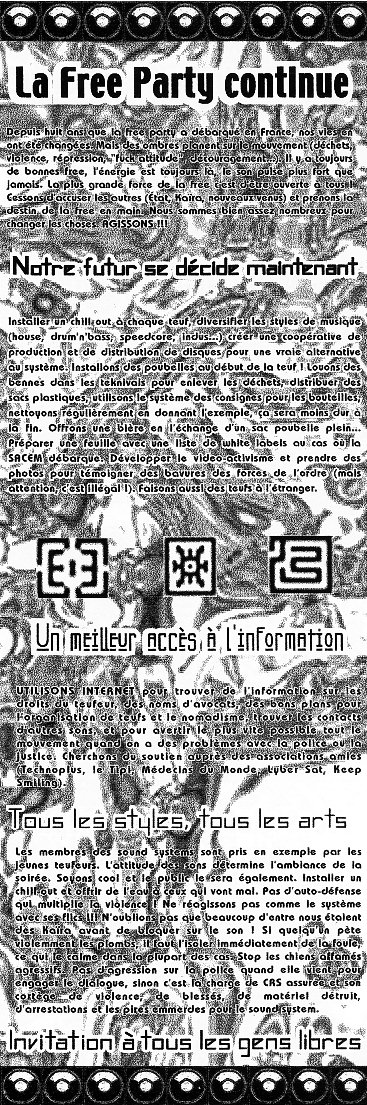
Keep Faith in da Free Party !

Depuis huit ans que la free party a débarqué en France, nos vies en ont été changées. Mais des ombres planent sur le mouvement (déchets, violence, répression, "fuck attitude", découragement...). Il y a toujours de bonnes frees, l'énergie est toujours là. La plus grande force de la free c'est d'être ouverte à tous !
Cessons d'accuser les autres (état, Ka�ra, nouveaux venus) et prenons la destin de la free en main. Nous sommes bien assez nombreux pour changer les choses. AGISSONS !!!


Let's build the Future Now !

Installer un chill out à chaque teuf , diversifier les styles de musique (house, drum'n'bass, speedcore, indus...)
créer une coopérative de production et de distribution de disques pour une vraie alternative au système.
Installons des poubelles au début de la teuf ! Louons des bennes dans les teknivals pour enlever les déchets, distribuer des sacs plastiques, utiliser le système des consignes pour les bouteilles, nettoyer régulièrement en donnant l'exemple, ca sera moins dur à la fin. Offrir une bière en l'échange d'un sac poubelle plein...
En achetant un timbre fiscal pour débit de boisson disponible dans tous les tabacs, on a ensuite 2 semaines pour régulariser et les flics ne peuvent rien dire.
Préparer une feuille avec une liste de white labels au cas où la sacem débarque.
Développer le video-activisme et prendre des photos pour témoigner des bavures des forces de l'ordre.
Squatter les terrains militaires : la police n'a pas le droit de pénétrer, et les militaires n'ont pas le droit d'arrêter les civils ! Faisons des teufs à l'étranger, l'ambiance est fantastique.

Tuesday, March 23, 2010

HERETIK IS DEAD

Not that I personally agree. Still Decided to share it with you.
---

Après plus de 20 ans d'existence, forcé de constater que la free party, cette comète qui a marqué
nos vies et mis en appétit nos plus folles espérances, n'est plus que l'ombre d'elle-même.

Les valeurs et les espoirs que l'on trouvait dans ces fêtes sont aujourd'hui éteints,
ou tellement affaiblis que l'on n'en discerne plus la lueur en ces pénombres actuelles qu'elles traversent.

Jetons un dernier regard sur ce que sont devenues ces fêtes aujourd'hui, avant de clore le chapitre
et de s'ouvrir sur l'avenir.

La free party est aujourd'hui ce qu'elle aurait pu être de pire : un CLICHÉ.

Et la carte postale n'est pas belle. On défendait des valeurs écologiques, des idées de retour à la nature,
et voilà qu'aujourd'hui on pourrit tout, plus sauvagement encore que ne le faisaient ceux que l'on considère
comme nos ennemis. Ici, le saccage est gratuit.

On revendiquait des idées d'ouverture, de découverte, de recherche et d'innovation artistique, et voilà qu'en tout domaine ces valeurs sont renversées :


--------------------------------------------------------------------------------


* La musique se standardise et se referme sur elle-même et le public n'en demande pas mieux.

* Les autres activités artistiques ne se renouvellent pas, elles s'amoindrissent au contraire,
et rien de nouveau ne vient alimenter la fête qui s'étouffe et agonise.

* La drogue n'est plus là à des fins initiatiques, mais est utilisée de manière barbare, irréfléchie, insensée.
D'outil, elle est devenue PRODUIT.

* Les gens ne fraternisent plus, ils sont anesthésiés par les produits,
refermés sur eux-mêmes, paranoïaques, violents, avides d'argent. Ils ont reproduit en pire l'ambiance
et les schémas sociaux habituels dans ces îlots d'espoir qu'étaient les free.

* La fête, de lieu de liberté et d'expérimentation, est devenue supermarché grotesque,
prétexte à tous les abus et à toutes les incohérences.
Elle a perdu son âme, et tout le monde semble s'en contenter. C'est le règne de l'absurde.


--------------------------------------------------------------------------------

La free party n'est plus qu'un prétexte pour détruire et se détruire. Certes, beaucoup de contre-exemples,
beaucoup de petits espoirs peuvent çà et là remettre en doute ces propos, mais une observation générale
montre bien à quel point la chose est pervertie.


Il faut aujourd'hui continuer à se battre sur d'autres terrains, en d'autres lieux et de manière différente.
Rien n'est jamais fini, et surtout pas l'espoir. Autre chose va naître, ailleurs, sous une autre forme,
c'est peut-être déjà en cours et c'est à nous d'être assez vigilant pour y participer.

** Texte d'Heretik **