SPONSORS

Showing posts with label INTERVIEW. Show all posts
Showing posts with label INTERVIEW. Show all posts
Sunday, January 11, 2015
FEAR AND LOATHING ON THE ROAD TO HOLLYWOOD
Omnibus: Season 12, Episode 8
Fear and Loathing on the Road to Hollywood (2 Nov. 1978)
TV Episode - 51 min
BBC program Omnibus features Nigel Finch's 50-minute 1978 documentary of Hunter S. Thompson and Ralph Steadman titled "Fear And Loathing In Gonzovision" at the beginning and "Fear And Loathing On The Road To Hollywood With Dr. Hunter S. Thompson And Ralph Steadman" at the end.
Fear and Loathing on the Road to Hollywood: The BBC’s 1978 Portrait of Hunter S. Thompson

Labels:
DOCU,
HUNTER S. THOMPSON,
INTERVIEW

Tuesday, April 2, 2013
DMCWORLD INTERVIEWS SP23 CREW
DMCWORLD magazine published an interview with Stray Wayward (aka Spiral Mark) and Sirius, both members of the SP23 crew
(sp23.org). SP23 is creative collected formed by some of the core members of the Spiral Tribe soundsystem.
Mark is currently working on a book I am really, really.. really looking forward to. What makes me so anxious is that I am almost certain that this book will be THE book I would be able to call my bible. In "A Darker Electricity: Life On The Road With Spiral Tribe" Mark will chose to tell the story of Spiral Tribe in a creative way by weaving narrative threads together and not just create a chronological list of events. Thus creating an interesting storyline I am dieing to dig in to. Finally I will be able to read the whole story of which I now know only a few scraps I picked op from interviews, articles, flyers and other media we once searched and shared on this blog. One of the main reasons we started this blog is to collect all the information that was available online and make sure it doesn't get lost. Many websites from soundsystems in the early 90's were disappearing so we wanted to make sure that these pieces of history wouldn't get lost. Creating one place to find out more about the history of the current free tekno movement. Especially the legend of Spiral Tribe which became a great source of inspiration that became a part of the free person I am now. A part of the manifesto I put together a few years ago, which sums up what we stand and fight for as a soundsystem, is based on the reason why Spiral Tribe was formed. A group of friends got together to resist the system that limits our own creativity and freedom of expression. Their weapon in this battle was Spiral Tribe. Re-read our manifesto and you'll know which part I am referring to. 23 years later these constrains are still being enforced by governments but also still resisted by many collectives in the form of a soundsystem all over the world. Their cause became a message I now follow and actively spread. I could go on about how much influence Spiral Tribe actually had on my life but I just realized I was just mentioning the upcoming book "A Darker Electricity" and got off track. So my train of thought ends here and the influence of Spiral Tribe in my life will become a post on its own in the near future.


What was it about the whole free party movement that attracted you?
Mark: "I grew up going to free festivals. Stonehenge and Avebury. Something magical occurs when you escape the confines and routines of the locked-down mainstream. It's a combination of things: the community bonds that you feel while dancing together across the night – under the stars; the connection with nature; and a sense that you've stepped outside of a bubble and into the wider world... It's an escape – not away from reality but into reality."
Mark: "I grew up going to free festivals. Stonehenge and Avebury. Something magical occurs when you escape the confines and routines of the locked-down mainstream. It's a combination of things: the community bonds that you feel while dancing together across the night – under the stars; the connection with nature; and a sense that you've stepped outside of a bubble and into the wider world... It's an escape – not away from reality but into reality."

Labels:
BOOK,
INTERVIEW,
NETWORK 23,
SOUND CONSPIRACY,
SPIRAL TRIBE
Monday, March 18, 2013
CHASSEURS DE SKINS

Antifa - "Skinhead hunters"
Documentary about the rise of neo-nazi skinhead culture in 1980s Paris and how they were countered by a militant, multicultural underground movement. Contains interviews with participants recounting the subcultures and the street fights which made up their lives at the time. (description grabbed from a vimeo upload by Libcom.org)
English subtitles are hard-coded
Fighting fascism by any means necessary!
Labels:
ANARCHY,
COUNTERCULTURE,
DOCU,
INTERVIEW
Friday, July 27, 2012
HISTORY OF SQUATTING IN THE UK

Jim is a resident of London, England, and a long-time organizer with the Advisory Service for Squatters, A.S.S. Here he speaks about the history of squatting in the UK, going as far back as the 1300's. This interview looks at squatting's relationship to the anarchist movement in the UK, the changing legal framework around squatting, and squatting within a framework of other social movements in the country.
The Advisory Service For Squatters is a collective of unpaid workers who have beenrunning a daily advice service for squatters and homeless people since 1975. It grewout of the former Family Squatters Advisory Service, which was founded in the late 1960's. ASS publishes The squatters Handbook, the twelfth edition of which is the current one, and has sold in excess of 150,000 copies since 1976. ASS offers advice on how to squat, legal help to squatters and helps fight evictions and challenge police abuse of the homeless.
READ THE INTERVIEW HERE
or just listen to the interview via radio4all.net

Images via the UK Squating Archive
Labels:
ANARCHY,
AUTONOMY,
COUNTERCULTURE,
INTERVIEW,
LONDON,
SQUATS,
TRAVELLERS
Wednesday, May 23, 2012
ZONING OUT (TEMPORARILY)
Zoning Out, Temporarily with Hakim Bey and Genesis P-Orridgeby John Perry Barlow, Mondo 2000 No. 9 1993

It was Queen Mu who made this happen - her conspiratorial whisper suggesting that I get myself together with Hakim Bey, Genesis P-Orridge, and a MONDO tape recorder. I wasn't too sure what she had in mind.
I mean, aside from the fact that all three of us are white, male acid-altered, old enough to know better, and crazy enough to do it anyway... Our resumes just didn't hook up and I wondered if we would.
Mr. Orridge, for example, is one singular fellow. He's got hardware dangling all over a body which sports more ritual scars and tattoos than Melville's Queequeg (with whom he shares other characteristics, most notably a nightmarish appearance cloaking a sweet and reasonable mind). He also happens to be the father of modern primitivism, the post-industrial tribes, the Rave Movement, the avant-garde band Psychic TV, and a couple of beautiful young daughters.
Orridge has been willfully causing such grave offense to British proprietary for the last twenty years that they've finally seen no alternative but to seize all his works and archives and pass laws which, though tailored to outlaw him, also make it a crime to give any other British subject so much as a hickey. (Or cause any physical harm to oneself or another consenting adult in the pursuit of dark pleasures.)
Finally, agents of the Crown have sent him packing into exile in California - a place so much more congenial to abominations that Mr. Orridge is having to scratch around for something to sink his sharpened teeth into.
Hakim Bey is another whose deviances have forced him to hide behind another name. Spending much of his life disguised as a mild-mannered comparative religion scholar, he emerges in print as an anarcho-gay drug fiend and Sufi pirate, compared to whom Salmon Rushdie is as orthodox as an ayatollah. Hakim's the guy who put the Temporary Autonomous Zone on the map.
However similar they might seem in their jointly unspeakable practices, their unabashedly unnatural acts, Bey and Orridge are quite different. Bey is reclusive and ascetic, a closeted natural philosopher, whereas Orridge is a performer, indeed something of a rock star.
And there's my own staid self, known to MONDO readers as a retired cattle rancher, rural gentlemen of such probity that, a couple years ago, I came within one vote of a Republican state senate seat in Wyoming, the most conservative part of the non-Islamic world. I'm a Freemason, a jack-Mormon, and a problem if I've been drinking. In short, just about everything these two are not.
And yet...
When, by virtue of a couple minor miracles, I was able to horse all three of us into my borrowed apartment in San Francisco's Potero Hill, a curiously complete zone of shared understanding arose between us. It felt as if we'd been opining around the same cracker barrel for years. During the hour and a half this field remained intact, we covered a vast stretch of philosophical country which the hacked and decimated thing below can only hint at.
-John Barlow
JOHN PERRY BARLOW: I want to talk with you guys about the Shadow. There is a way we have of concealing, projecting or wearing - in a peculiar fashion - that which we don't want to admit about ourselves. The thing that's interesting to me about you, Genesis, is that you look like an evil sonuvubitch from a distance. You look like a goddamn cannibal. And yet you are an extremely pleasant, polite, decent fellow.
GENESIS P-ORRIDGE: I think I look really West Coast.
HKIM BEY: I'm reading Hermes by Michel Sarres. And he brought up an interesting idea. He was talking precisely about this duality in Western culture... that there's always the on/off, dark/light, good/bad, up/down. He says that the third person is lost in Western discourse. Where any two are, there's a the third who has to be ignored. Apparently, he's going to suggest ways in which the third person can be re-integrated. Perhaps that's what we need, instead of paradox. He even calls it "the parasite" - the guest who gives words for food instead of food for food. The interlocutor... the third interlocutor.
GEN: Have you read The Third Mind by Brion Gysin? When he and William Burroughs came together and applied the cut-up method to their text, they produced a third mind.
HAKIM: ...as a parasite on that interaction! That's what Sarres is talking about.
GEN: I always found The Third Mind one of the most interesting subversive manuals. I never recommend the novels and stories of Burroughs or Gysin, I just say read The Third Mind and try some of those exercises. A lot of implications concerning inherited perception are revealed.
Scotland Yard has now got lots of videotapes that I made of Brion in Paris talking about psychic hygiene, the alchemical variations in the temperatures of boiling water, through the Master Musicians of Jajouka, all the events in Morocco that led him to many of his most intimate theories, even explaining how to make a good cup of tea by detailed observation of the bubbles, each of which he had named to denote each step. There's a lot of unique stuff there.
JOHN: I think they suppress that stuff mainly because they're afraid its reality could disturb what they wish to project about it. The image of Burroughs or you is so much easier to abuse. That's the scary thing about the information society - mythology completely detached from any reality but the one it's in the business of manufacturing. Pure simulation.
HAKIM: You know, the big difference between shamanic cultures and religious cultures is that dualistic shadow/anti-shadow thing is missing from shamanic culture. It was pre-Manichean, and now we're looking for something which is post-Manichean. Urban shamanism.
JOHN: I saw a very old Tantric Buddhist shrine near Kyoto. And the central icon of this place was a large sculpture of two dragons- one on the top with his tail coming up, and the other on the top, with his tail going down, entwining with the first dragon's tail around the middle. It reminded me of the Caduceus and its snakes, except that implied no value judgment between the upper and lower chakras. The point was the even interaction of the tails in the middle. So there was a duality, but it wasn't a weighted duality. It was more like a Yin/Yang.
HAKIM: No. The Yin/Yang theory is not Gnostic dualism. It's not the same thing. Eliade called it "dyadic." It's not the same as good and evil. It becomes so later in neo-Confucian thinking.
JOHN: Right, Taoism has no truck with good and evil at all.
HAKIM: Taoism seems to be the one religion that doesn't have the Gnostic trace.
JOHN: In our culture, the problem arose with the Romans.
HAKIM: I think it goes further back. It's Babylon. It's just like the Rastas say, "It happened in Babylon." It's Marduk and Tiamat. It's Mr. Hard-on God up against Sloppy Mom. In China, chaos is a benevolent property. Huntun is the gourd or the egg out of which everything comes. He's a wonton. Huntun and wonton are the same words. He's like this little dumpling and everything good comes out of him. In Babylon, chaos is the disgusting monster vagina that has to be ripped up by Marduk into myriad blobs of shit and slime. And we are those globs of slime. That's how the human race came into being. What is the purpose of the human race? To serve Marduk, to serve the masculine principle, to store up grain in the granary for the priests, to pay for the priests for their sacrifice so they get the free hamburgers. That's the whole Western myth. It's St. George and the Dragon. St. George pins the dragon down.
In China, the dragon is the free expression of creativity. He's the mixture of Yin and Yang, the principle of power. But here's evil, plain and simple. This is why chaos has kicked off, for me, for Ralph Abraham, and others, an interest in making a critique of this Western mythology, and saying, "Let's put Humpty Dumpty back together."
JOHN: There's been an interesting co-evolution lately of a lot of apparently disconnected things, like chaos mathematics and neo-tribalism, a sudden interest in Taoism and what I perceive to be a deep feminization of Western culture.
GEN: Some philosophers feel that there's a risk in absolute unconditional surrender of that male-God power, even though it's obviously failed miserably. Should we seek out every possible male trait and subordinate it to a female principle?
HAKIM: I didn't like the rule of Dad, but I don't think I'm going to like the rule of Mom either.
GEN: I'm involved with raves and live events because they're celebrations of an autonomous tribal unit. I think that was one of the real reasons for the attack on Psychic TV. It was the fact that we were doing unannounced, unadvertised, private parties where three thousand young people would aways turn up and bring one more friend next time. We were building this entire, separate, parallel vision - what Alaura calls "The Lost Tribe." We would discuss taboos, body modifications, self-empowerment, women's rights, animal rights, and all these different things as a spin-off. They weren't any of them essential in themselves. But what people always kept saying, over and over again, was that they felt they could relax and be themselves. The most obvious, ordinary condition that so very rarely happens.
JOHN: That's also why they go to Grateful Dead concerts. It's a sense of belonging which makes it possible for you to be yourself. When you're part of somethign on an organic level, then the self has some meaning. If you're only...
HAKIM: What about the problem of mediation? It sounds to me like you're less interested in media and more interested in the immediate, the un-mediated. A street concert is participator. It's got to be something you experience.
JOHN: Until McDonald's finds out about it and turns it into an ad.
GEN: Basically, the way you set your events up is the key to whether or not they're absorbed. And so far we haven't been absorbed. That's why we're being spat out. If your tension is not to sell yourself and your imagination, then there's a real problem with people in authority, because their normal debilitiser is the money carrot. They have a really patronizing view of the creative mind, that it really want to whore itself to them.
JOHN: Most commerce in this country is based on the unfulfilled psychic needs. The media have one message: "Eat this, drink that, wear this, put this on your body, do something about the horrible loathsome disconnected thing that you are."
HAKIM: The trick is that none of it works. It's what Walter Benjamin calls the "Utopian trace," which is built into those commodities that make you dream of the perfection that's being sold to you. But it's only a trace, like a trace element. It's like homeopathic; it's hardly even there. So, of course, it doesn't work.
JOHN: Recently I was on an NBC show about LSD. And they also had a self-described "recovering LSD addict." It was a real set-up. But I noticed that almost every ad was either for a drug or for something that would make everything somehow different. So the LSD which actually can make you different in a fundamental and satisfying way, represented the Demonic. LSD was the Shadow.
HAKIM: I read a quote from Malcom McLaren, where he said, "Why are drugs popular? I'll tell you. Because only drugs can make you feel like people in TV ads look like they're feeling." Drugs are the only commodity that's actually more than just a trace. It is - in some ways - the thing.
JOHN: It's close. And that makes it an enormous threat to the culture, which is base don unfulfillable need.
HAKIM: The best way to impose stability is through violence. Within every rational system is terror and death, unless you admit the third mind... the parasite. As long as linear reason calls the shots, it's always death and terror.
GEN: There's a great tape of Gyson, Gregory Corso, and Burroughs in Paris during the 50's. A letter arrives from some businessman in London, and you can actually hear Burroughs as he snips it with his scissors saying, "Now let's see what it really says." And then he reads it aloud and it basically goes, "... money... money ... money." I took that very much to heart. When in doubt, be extreme and see what it really says. There's a need for people to smash the shop windows because that debris can be reassembled into amazing things.
JOHN: There's a particular need when you've got a culture which has placed such an inordinate value on stability. We'll have to go some distance to re-assert the dynamic.
HAKIM: That's what's so useful about chaos and complex dynamical system analysis, which is now cutting edge. It's going to take a while. The popular discourse is still Cartesian.
So what's the social anti-spasmodic for the spasms we've been talking about? Again, what about... tactics?
JOHN: The best anti-spasmodic is a joke. Take a leaf from Catastrophe Theory, which is really the science of the punch line. IT's the thing that suddenly takes you out of the locks system and helps you go meta.
There's a great Neal Cassady story about this. The PRanksters all went into a bar in Oakland after a rally in Berkeley, and everybody was high on acid. It turned out to be the wrong kind of bar. Basically, there was a group of guys about to pretty much disembowel someone. But it was a perfectly symmetrical situation with nowhere for things to go but bad. Cassady strutted over to the assailant group, and said, "Hey, anybody want some gum?" And this was the catastrophe that caused the whole thing to dematerialize. For these locked symmetries, the most powerful cure is the prank.
HAKIM: That's an interesting way of looking at it. Poetic terrorism. Pirate humor.
GEN: That's why Dada and surrealism and happenings and acid and cut-ups are actually tools of survival.
HAKIM: They're anti-spasmodics.
GEN: It's really empowering when you break up or collage stuff together, bring in the unexpected or the inappropriate. Those who are trying to impose the status quo and a linear view can't read that language.
JOHN: It's too ambiguous for neurotics.
GEN: They're unable to deal with the anarchic, confused, colliding, or absolutely illogical combinations. Tim Leary believes that's what is really behind the attacks on us. What SCotland Yard is actually attacking is my archive. For over 25 years I've collected things that don't fit together. I've got Dada stuff, Fluxus stuff, Brion Gysin's stuff, Burroughs' stuff, Leary's stuff... psychedelic, tragic, radical, trivial, random, and mathematical stuff. And we have no "agenda," as they like to say these days.
We've followed the logical path. One day we just sold a spare Austin Osman painting to Chris Stein [of Blondie] and left. We spent time in Thailand, then we went to Nepal. Nepal was an amplifier and the confirmation of so many threads we have been unraveling and following for so much of our lives. The basic premise being AGORI... the path of no distinction. In this, everything is equal. There is on Shadow. All aspects of life and death, the minute to grandiose scales are fully integrated. Thus, no comment upon this amazing state of affairs is necessary. The most fabulous is commonplace. Devotion is as ordinary as taking a breath... and, of course, as extraordinary. We'd leave the hotel and cross the river, and there'd be dead dogs floating in sacks, or lodged in the mud banks with huge pigs eating their remains. There'd be children's corpses being cremated on the burning chats, their ashes swept into the same river while, further downstream, women were washing their cooking pots. Next to the burning children, there'd be workers eating breakfast, lepers begging, tourists taking pictures, Hindus prostrate... all in devotion , all simply living...
That's where we were just as we were being attacked in England. And thus we were better able to deal with the attack and its ramifications. We were able to say, "So what?" I mean, here were the Tibetans dealing with genocide. They've lost everything and yet they were embracing us without asking "Who are you, what do you believe, what do you do...?" There was a deeper sense of connection and recognition that instantly allowed us all to converse and be together. No justification was necessary. Ah, blessed relief! In the same way, the Shiva saddhus, the Nagas and the Agoria Baba... all highly evolved, threshold pushing, ascetic strands of Hinduism that believe in the "Path of No Distinction" ... they welcomed us too. We were on a bridge at Pashapati, near the main burning ghats, when suddenly the most revered holy man of the Agori was standing by us in his dreadlocks, and took us into his chamber where Europeans are not ordinarily allowed. There we sat around a fire which hasn't gone out once in over a thousand years. We exchanged spontaneous gifts, suspended Western categories of thought, and absorbed the peace of primal vision. To be trusted is such a fabulous gift, even greater when one is given that trust under no obligation. The Agori Baba gave us a white ash form the thousand-year-old-fire, "to take with you to bless America" he said.
Strength. We've kept that strength through everything that's happened since then. It's very reassuring, an embrace in a realm beyond thought or sense. It is this momentary experience of "belonging" that is carrying us through; this basic task of navigating through the unexpected conjoining and juxtaposition, grappling with the grinding together of things is like learning a martial art. To bend, flow, parry, using the strengths and rushes as our own muscles.
That's the first step, getting these survival tools. Then the game is: do we finally evolve, or not? I talk about a human(e) race where the extra "e" is added to suggest ecstasy, eager, evolutionary, evil, experiential, egolessness, etc. In other words, whatever happens next. Above all else, a risk-taking explosion with the eeego tacked onto this story. We are each there within this mystery. We're at a point where there's going to be an evolution away from the previous static system into the embracing of chaos.
HAKIM: I don't think that we're evolving towards anything, in the Teilhard de Chardin sense of evolution being directed toward the collective organism of human mind. I have a lot of problems with that. But if you start to look at the way the world is going: political - you have a fragmentation of structure that is devolving down to smaller and smaller discrete communities at the same time that there's a globalization going on, then you can start to think of the paradoxical interaction of the global mind, the "all mind," becoming an increasingly coherent unity, even as individuation is becoming more profound. That seems hopeful, to me.
The problem is looking at it as an Omega Point. It's still teleological. And not only that, it's unjust. Because if Paleolithic human and medieval human and modern human are excluded from that Omega Point, then God is even a worse sonuvabith than we suspected. That's what I've always objected to in Teilhard, and that's the problem I have with the idea of an evolution. I can't see it as an evolution. I see it as an infolding. Change. This is why I've tried to develop the idea of the Temporary Autonomous Zone. Because I'm sick and fucking tired of waiting for the revolution or the evolution. A certain degree of selfishness is required. And that selfifshness also involves an altruism, because what I want for myself obviously must be available to the other.
I want to get away from the Newtonian force and talk about the power in a fractal design. It's not teleological, nor vitalistic. It's not pointing to the future. It's not pointing to the past. Ilya Prigogine talks about "creative evolution," which to me is an infolding. It doesn't fold itself out towards the future, but it infolds itself towards desire.
JOHN: The basin of attraction.
HAKIM: The basin of attraction is the infolding of desire.
GEN: Basically, if what you're doing is dragging people across the line of what they'll accept, then it's endorseable. It was actually Tim Poston, my catastrophe theory friend, who gave me direction in this area. We did a magazine together called Delusions of Grandeur in the 60's. The original slogan was "The Possibilities Alone are Endless." As he pointed out, the "The Impossibilities are Endless" too, as are all those phenomena which are neither possible nor impossible. The addenda are implied, not necessarily alluded to. There is a geological term I was made aware of later by a kinetic artist named Gerald Fitzgerald. (He was a prime mover in the Exploding Galaxy fluxus and happening group at the time, along with Derek Jarman and myself.) The term is quaquaversal, which means "pointing in every direction simultaneously."
JOHN: The challenge, at this point, is learning to read the tea leaves in such a fashion that your interpretive assumptions bear some relationship to the next person's. So your society doesn't just dissolve into babble; so you're not isolated by everybody's unique magical universe. One approach might be the ritualization and the re-tribalization of society. The point isn't that we agree. The point is that we all dance.
HAKIM: Nietzche said that if we want to be a dancing star, we must have chaos within us. So, already in the 1880's, this concept was out there.
JOHN: Well, it was out there long before Nietzsche. Don't forget Shiva.
GEN: That's one of the most rejuvenating things about traveling in the Far East. There's a deep sense of continuity, a time-depth to the exploration.
HAKIM: It's only a very small time we've had history. It's useful to think of history as this thin layer of slime over a huge sea of the Paleolithic. It's not a question of a return to the Paleolithic but a return of the Paleolithic.
GEN: Now we really don't even belong to Her Majesty. We were subject. Theoretically, we were actually owned by Her Majesty.
HAKIM: Along with the swans and Scottish Deerhounds.
GEN: I'm basically on the run and feeling good about it. The Global Village definitely seems to be forming. We're commuting to Japan. The Japanese are commuting here. Computer terminals and modems are linking people up. In all this action forms the wraith-like Global Village. There seem to be a lot more doors and windows left open than there were a few years ago.
On the good days - which are many - we think about sending postcards to D.C. Yeoull at Scotland Yard. Pictures of us on the beach in Thailand or giving rice and dal to lepers in Kathmandu, or onstage with Timothy Leary, or sitting by a fire here in California with our creek in the background. We think of saying, "D.C. Yeoull! Thank you very much for your interest in our work, and more importantly, for letting us go free so we can finally travel this world and do so much more of it!"
HAKIM: Jesse Helms deserves a few letters like that too.
GEN: Did I tell you what Yeoull said when some friends of mine went and tried to demand our archive back? He said, "My job, as I see it, is to rid the world once and for all of this art scum." [laughter]
There's a lot to be said for the fanatic on your tail.
HAKIM: A good enemy is hard to find in this wishy-washy world of ours.
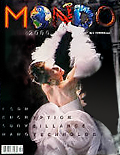
It was Queen Mu who made this happen - her conspiratorial whisper suggesting that I get myself together with Hakim Bey, Genesis P-Orridge, and a MONDO tape recorder. I wasn't too sure what she had in mind.
I mean, aside from the fact that all three of us are white, male acid-altered, old enough to know better, and crazy enough to do it anyway... Our resumes just didn't hook up and I wondered if we would.
Mr. Orridge, for example, is one singular fellow. He's got hardware dangling all over a body which sports more ritual scars and tattoos than Melville's Queequeg (with whom he shares other characteristics, most notably a nightmarish appearance cloaking a sweet and reasonable mind). He also happens to be the father of modern primitivism, the post-industrial tribes, the Rave Movement, the avant-garde band Psychic TV, and a couple of beautiful young daughters.
Orridge has been willfully causing such grave offense to British proprietary for the last twenty years that they've finally seen no alternative but to seize all his works and archives and pass laws which, though tailored to outlaw him, also make it a crime to give any other British subject so much as a hickey. (Or cause any physical harm to oneself or another consenting adult in the pursuit of dark pleasures.)
Finally, agents of the Crown have sent him packing into exile in California - a place so much more congenial to abominations that Mr. Orridge is having to scratch around for something to sink his sharpened teeth into.
Hakim Bey is another whose deviances have forced him to hide behind another name. Spending much of his life disguised as a mild-mannered comparative religion scholar, he emerges in print as an anarcho-gay drug fiend and Sufi pirate, compared to whom Salmon Rushdie is as orthodox as an ayatollah. Hakim's the guy who put the Temporary Autonomous Zone on the map.
However similar they might seem in their jointly unspeakable practices, their unabashedly unnatural acts, Bey and Orridge are quite different. Bey is reclusive and ascetic, a closeted natural philosopher, whereas Orridge is a performer, indeed something of a rock star.
And there's my own staid self, known to MONDO readers as a retired cattle rancher, rural gentlemen of such probity that, a couple years ago, I came within one vote of a Republican state senate seat in Wyoming, the most conservative part of the non-Islamic world. I'm a Freemason, a jack-Mormon, and a problem if I've been drinking. In short, just about everything these two are not.
And yet...
When, by virtue of a couple minor miracles, I was able to horse all three of us into my borrowed apartment in San Francisco's Potero Hill, a curiously complete zone of shared understanding arose between us. It felt as if we'd been opining around the same cracker barrel for years. During the hour and a half this field remained intact, we covered a vast stretch of philosophical country which the hacked and decimated thing below can only hint at.
-John Barlow
JOHN PERRY BARLOW: I want to talk with you guys about the Shadow. There is a way we have of concealing, projecting or wearing - in a peculiar fashion - that which we don't want to admit about ourselves. The thing that's interesting to me about you, Genesis, is that you look like an evil sonuvubitch from a distance. You look like a goddamn cannibal. And yet you are an extremely pleasant, polite, decent fellow.
GENESIS P-ORRIDGE: I think I look really West Coast.
HKIM BEY: I'm reading Hermes by Michel Sarres. And he brought up an interesting idea. He was talking precisely about this duality in Western culture... that there's always the on/off, dark/light, good/bad, up/down. He says that the third person is lost in Western discourse. Where any two are, there's a the third who has to be ignored. Apparently, he's going to suggest ways in which the third person can be re-integrated. Perhaps that's what we need, instead of paradox. He even calls it "the parasite" - the guest who gives words for food instead of food for food. The interlocutor... the third interlocutor.
GEN: Have you read The Third Mind by Brion Gysin? When he and William Burroughs came together and applied the cut-up method to their text, they produced a third mind.
HAKIM: ...as a parasite on that interaction! That's what Sarres is talking about.
GEN: I always found The Third Mind one of the most interesting subversive manuals. I never recommend the novels and stories of Burroughs or Gysin, I just say read The Third Mind and try some of those exercises. A lot of implications concerning inherited perception are revealed.
Scotland Yard has now got lots of videotapes that I made of Brion in Paris talking about psychic hygiene, the alchemical variations in the temperatures of boiling water, through the Master Musicians of Jajouka, all the events in Morocco that led him to many of his most intimate theories, even explaining how to make a good cup of tea by detailed observation of the bubbles, each of which he had named to denote each step. There's a lot of unique stuff there.
JOHN: I think they suppress that stuff mainly because they're afraid its reality could disturb what they wish to project about it. The image of Burroughs or you is so much easier to abuse. That's the scary thing about the information society - mythology completely detached from any reality but the one it's in the business of manufacturing. Pure simulation.
HAKIM: You know, the big difference between shamanic cultures and religious cultures is that dualistic shadow/anti-shadow thing is missing from shamanic culture. It was pre-Manichean, and now we're looking for something which is post-Manichean. Urban shamanism.
JOHN: I saw a very old Tantric Buddhist shrine near Kyoto. And the central icon of this place was a large sculpture of two dragons- one on the top with his tail coming up, and the other on the top, with his tail going down, entwining with the first dragon's tail around the middle. It reminded me of the Caduceus and its snakes, except that implied no value judgment between the upper and lower chakras. The point was the even interaction of the tails in the middle. So there was a duality, but it wasn't a weighted duality. It was more like a Yin/Yang.
HAKIM: No. The Yin/Yang theory is not Gnostic dualism. It's not the same thing. Eliade called it "dyadic." It's not the same as good and evil. It becomes so later in neo-Confucian thinking.
JOHN: Right, Taoism has no truck with good and evil at all.
HAKIM: Taoism seems to be the one religion that doesn't have the Gnostic trace.
JOHN: In our culture, the problem arose with the Romans.
HAKIM: I think it goes further back. It's Babylon. It's just like the Rastas say, "It happened in Babylon." It's Marduk and Tiamat. It's Mr. Hard-on God up against Sloppy Mom. In China, chaos is a benevolent property. Huntun is the gourd or the egg out of which everything comes. He's a wonton. Huntun and wonton are the same words. He's like this little dumpling and everything good comes out of him. In Babylon, chaos is the disgusting monster vagina that has to be ripped up by Marduk into myriad blobs of shit and slime. And we are those globs of slime. That's how the human race came into being. What is the purpose of the human race? To serve Marduk, to serve the masculine principle, to store up grain in the granary for the priests, to pay for the priests for their sacrifice so they get the free hamburgers. That's the whole Western myth. It's St. George and the Dragon. St. George pins the dragon down.
In China, the dragon is the free expression of creativity. He's the mixture of Yin and Yang, the principle of power. But here's evil, plain and simple. This is why chaos has kicked off, for me, for Ralph Abraham, and others, an interest in making a critique of this Western mythology, and saying, "Let's put Humpty Dumpty back together."
JOHN: There's been an interesting co-evolution lately of a lot of apparently disconnected things, like chaos mathematics and neo-tribalism, a sudden interest in Taoism and what I perceive to be a deep feminization of Western culture.
GEN: Some philosophers feel that there's a risk in absolute unconditional surrender of that male-God power, even though it's obviously failed miserably. Should we seek out every possible male trait and subordinate it to a female principle?
HAKIM: I didn't like the rule of Dad, but I don't think I'm going to like the rule of Mom either.
GEN: I'm involved with raves and live events because they're celebrations of an autonomous tribal unit. I think that was one of the real reasons for the attack on Psychic TV. It was the fact that we were doing unannounced, unadvertised, private parties where three thousand young people would aways turn up and bring one more friend next time. We were building this entire, separate, parallel vision - what Alaura calls "The Lost Tribe." We would discuss taboos, body modifications, self-empowerment, women's rights, animal rights, and all these different things as a spin-off. They weren't any of them essential in themselves. But what people always kept saying, over and over again, was that they felt they could relax and be themselves. The most obvious, ordinary condition that so very rarely happens.
JOHN: That's also why they go to Grateful Dead concerts. It's a sense of belonging which makes it possible for you to be yourself. When you're part of somethign on an organic level, then the self has some meaning. If you're only...
HAKIM: What about the problem of mediation? It sounds to me like you're less interested in media and more interested in the immediate, the un-mediated. A street concert is participator. It's got to be something you experience.
JOHN: Until McDonald's finds out about it and turns it into an ad.
GEN: Basically, the way you set your events up is the key to whether or not they're absorbed. And so far we haven't been absorbed. That's why we're being spat out. If your tension is not to sell yourself and your imagination, then there's a real problem with people in authority, because their normal debilitiser is the money carrot. They have a really patronizing view of the creative mind, that it really want to whore itself to them.
JOHN: Most commerce in this country is based on the unfulfilled psychic needs. The media have one message: "Eat this, drink that, wear this, put this on your body, do something about the horrible loathsome disconnected thing that you are."
HAKIM: The trick is that none of it works. It's what Walter Benjamin calls the "Utopian trace," which is built into those commodities that make you dream of the perfection that's being sold to you. But it's only a trace, like a trace element. It's like homeopathic; it's hardly even there. So, of course, it doesn't work.
JOHN: Recently I was on an NBC show about LSD. And they also had a self-described "recovering LSD addict." It was a real set-up. But I noticed that almost every ad was either for a drug or for something that would make everything somehow different. So the LSD which actually can make you different in a fundamental and satisfying way, represented the Demonic. LSD was the Shadow.
HAKIM: I read a quote from Malcom McLaren, where he said, "Why are drugs popular? I'll tell you. Because only drugs can make you feel like people in TV ads look like they're feeling." Drugs are the only commodity that's actually more than just a trace. It is - in some ways - the thing.
JOHN: It's close. And that makes it an enormous threat to the culture, which is base don unfulfillable need.
HAKIM: The best way to impose stability is through violence. Within every rational system is terror and death, unless you admit the third mind... the parasite. As long as linear reason calls the shots, it's always death and terror.
GEN: There's a great tape of Gyson, Gregory Corso, and Burroughs in Paris during the 50's. A letter arrives from some businessman in London, and you can actually hear Burroughs as he snips it with his scissors saying, "Now let's see what it really says." And then he reads it aloud and it basically goes, "... money... money ... money." I took that very much to heart. When in doubt, be extreme and see what it really says. There's a need for people to smash the shop windows because that debris can be reassembled into amazing things.
JOHN: There's a particular need when you've got a culture which has placed such an inordinate value on stability. We'll have to go some distance to re-assert the dynamic.
HAKIM: That's what's so useful about chaos and complex dynamical system analysis, which is now cutting edge. It's going to take a while. The popular discourse is still Cartesian.
So what's the social anti-spasmodic for the spasms we've been talking about? Again, what about... tactics?
JOHN: The best anti-spasmodic is a joke. Take a leaf from Catastrophe Theory, which is really the science of the punch line. IT's the thing that suddenly takes you out of the locks system and helps you go meta.
There's a great Neal Cassady story about this. The PRanksters all went into a bar in Oakland after a rally in Berkeley, and everybody was high on acid. It turned out to be the wrong kind of bar. Basically, there was a group of guys about to pretty much disembowel someone. But it was a perfectly symmetrical situation with nowhere for things to go but bad. Cassady strutted over to the assailant group, and said, "Hey, anybody want some gum?" And this was the catastrophe that caused the whole thing to dematerialize. For these locked symmetries, the most powerful cure is the prank.
HAKIM: That's an interesting way of looking at it. Poetic terrorism. Pirate humor.
GEN: That's why Dada and surrealism and happenings and acid and cut-ups are actually tools of survival.
HAKIM: They're anti-spasmodics.
GEN: It's really empowering when you break up or collage stuff together, bring in the unexpected or the inappropriate. Those who are trying to impose the status quo and a linear view can't read that language.
JOHN: It's too ambiguous for neurotics.
GEN: They're unable to deal with the anarchic, confused, colliding, or absolutely illogical combinations. Tim Leary believes that's what is really behind the attacks on us. What SCotland Yard is actually attacking is my archive. For over 25 years I've collected things that don't fit together. I've got Dada stuff, Fluxus stuff, Brion Gysin's stuff, Burroughs' stuff, Leary's stuff... psychedelic, tragic, radical, trivial, random, and mathematical stuff. And we have no "agenda," as they like to say these days.
We've followed the logical path. One day we just sold a spare Austin Osman painting to Chris Stein [of Blondie] and left. We spent time in Thailand, then we went to Nepal. Nepal was an amplifier and the confirmation of so many threads we have been unraveling and following for so much of our lives. The basic premise being AGORI... the path of no distinction. In this, everything is equal. There is on Shadow. All aspects of life and death, the minute to grandiose scales are fully integrated. Thus, no comment upon this amazing state of affairs is necessary. The most fabulous is commonplace. Devotion is as ordinary as taking a breath... and, of course, as extraordinary. We'd leave the hotel and cross the river, and there'd be dead dogs floating in sacks, or lodged in the mud banks with huge pigs eating their remains. There'd be children's corpses being cremated on the burning chats, their ashes swept into the same river while, further downstream, women were washing their cooking pots. Next to the burning children, there'd be workers eating breakfast, lepers begging, tourists taking pictures, Hindus prostrate... all in devotion , all simply living...
That's where we were just as we were being attacked in England. And thus we were better able to deal with the attack and its ramifications. We were able to say, "So what?" I mean, here were the Tibetans dealing with genocide. They've lost everything and yet they were embracing us without asking "Who are you, what do you believe, what do you do...?" There was a deeper sense of connection and recognition that instantly allowed us all to converse and be together. No justification was necessary. Ah, blessed relief! In the same way, the Shiva saddhus, the Nagas and the Agoria Baba... all highly evolved, threshold pushing, ascetic strands of Hinduism that believe in the "Path of No Distinction" ... they welcomed us too. We were on a bridge at Pashapati, near the main burning ghats, when suddenly the most revered holy man of the Agori was standing by us in his dreadlocks, and took us into his chamber where Europeans are not ordinarily allowed. There we sat around a fire which hasn't gone out once in over a thousand years. We exchanged spontaneous gifts, suspended Western categories of thought, and absorbed the peace of primal vision. To be trusted is such a fabulous gift, even greater when one is given that trust under no obligation. The Agori Baba gave us a white ash form the thousand-year-old-fire, "to take with you to bless America" he said.
Strength. We've kept that strength through everything that's happened since then. It's very reassuring, an embrace in a realm beyond thought or sense. It is this momentary experience of "belonging" that is carrying us through; this basic task of navigating through the unexpected conjoining and juxtaposition, grappling with the grinding together of things is like learning a martial art. To bend, flow, parry, using the strengths and rushes as our own muscles.
That's the first step, getting these survival tools. Then the game is: do we finally evolve, or not? I talk about a human(e) race where the extra "e" is added to suggest ecstasy, eager, evolutionary, evil, experiential, egolessness, etc. In other words, whatever happens next. Above all else, a risk-taking explosion with the eeego tacked onto this story. We are each there within this mystery. We're at a point where there's going to be an evolution away from the previous static system into the embracing of chaos.
HAKIM: I don't think that we're evolving towards anything, in the Teilhard de Chardin sense of evolution being directed toward the collective organism of human mind. I have a lot of problems with that. But if you start to look at the way the world is going: political - you have a fragmentation of structure that is devolving down to smaller and smaller discrete communities at the same time that there's a globalization going on, then you can start to think of the paradoxical interaction of the global mind, the "all mind," becoming an increasingly coherent unity, even as individuation is becoming more profound. That seems hopeful, to me.
The problem is looking at it as an Omega Point. It's still teleological. And not only that, it's unjust. Because if Paleolithic human and medieval human and modern human are excluded from that Omega Point, then God is even a worse sonuvabith than we suspected. That's what I've always objected to in Teilhard, and that's the problem I have with the idea of an evolution. I can't see it as an evolution. I see it as an infolding. Change. This is why I've tried to develop the idea of the Temporary Autonomous Zone. Because I'm sick and fucking tired of waiting for the revolution or the evolution. A certain degree of selfishness is required. And that selfifshness also involves an altruism, because what I want for myself obviously must be available to the other.
I want to get away from the Newtonian force and talk about the power in a fractal design. It's not teleological, nor vitalistic. It's not pointing to the future. It's not pointing to the past. Ilya Prigogine talks about "creative evolution," which to me is an infolding. It doesn't fold itself out towards the future, but it infolds itself towards desire.
JOHN: The basin of attraction.
HAKIM: The basin of attraction is the infolding of desire.
GEN: Basically, if what you're doing is dragging people across the line of what they'll accept, then it's endorseable. It was actually Tim Poston, my catastrophe theory friend, who gave me direction in this area. We did a magazine together called Delusions of Grandeur in the 60's. The original slogan was "The Possibilities Alone are Endless." As he pointed out, the "The Impossibilities are Endless" too, as are all those phenomena which are neither possible nor impossible. The addenda are implied, not necessarily alluded to. There is a geological term I was made aware of later by a kinetic artist named Gerald Fitzgerald. (He was a prime mover in the Exploding Galaxy fluxus and happening group at the time, along with Derek Jarman and myself.) The term is quaquaversal, which means "pointing in every direction simultaneously."
JOHN: The challenge, at this point, is learning to read the tea leaves in such a fashion that your interpretive assumptions bear some relationship to the next person's. So your society doesn't just dissolve into babble; so you're not isolated by everybody's unique magical universe. One approach might be the ritualization and the re-tribalization of society. The point isn't that we agree. The point is that we all dance.
HAKIM: Nietzche said that if we want to be a dancing star, we must have chaos within us. So, already in the 1880's, this concept was out there.
JOHN: Well, it was out there long before Nietzsche. Don't forget Shiva.
GEN: That's one of the most rejuvenating things about traveling in the Far East. There's a deep sense of continuity, a time-depth to the exploration.
HAKIM: It's only a very small time we've had history. It's useful to think of history as this thin layer of slime over a huge sea of the Paleolithic. It's not a question of a return to the Paleolithic but a return of the Paleolithic.
GEN: Now we really don't even belong to Her Majesty. We were subject. Theoretically, we were actually owned by Her Majesty.
HAKIM: Along with the swans and Scottish Deerhounds.
GEN: I'm basically on the run and feeling good about it. The Global Village definitely seems to be forming. We're commuting to Japan. The Japanese are commuting here. Computer terminals and modems are linking people up. In all this action forms the wraith-like Global Village. There seem to be a lot more doors and windows left open than there were a few years ago.
On the good days - which are many - we think about sending postcards to D.C. Yeoull at Scotland Yard. Pictures of us on the beach in Thailand or giving rice and dal to lepers in Kathmandu, or onstage with Timothy Leary, or sitting by a fire here in California with our creek in the background. We think of saying, "D.C. Yeoull! Thank you very much for your interest in our work, and more importantly, for letting us go free so we can finally travel this world and do so much more of it!"
HAKIM: Jesse Helms deserves a few letters like that too.
GEN: Did I tell you what Yeoull said when some friends of mine went and tried to demand our archive back? He said, "My job, as I see it, is to rid the world once and for all of this art scum." [laughter]
There's a lot to be said for the fanatic on your tail.
HAKIM: A good enemy is hard to find in this wishy-washy world of ours.
Wednesday, August 10, 2011
NO HOPE BY SAM BAIN
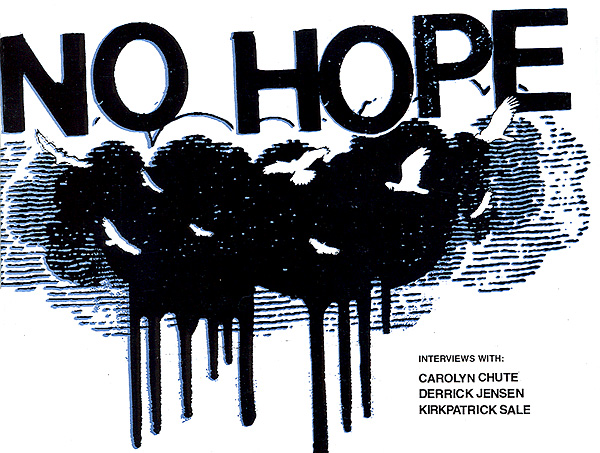
No Hope is a book of conversations with authors Carolyn Chute, Derrick Jensen and Kirkpatrick Sale. Breaking through the postmodern condition of alienation, the authors ponder human origins, anarchy, and the collapse of industrial civilization.
Tuesday, April 19, 2011
ATR INTERVIEW

As the struggle between social struggles intensifies all over Europe, a band who have never hidden their anarchist views have regrouped and started playing live shows again. Atari Teenage Riot (ATR) are back after a ten year break and have plenty to say about society, politics and economics in the second decade of the 21st century. We pose some timely questions to founding member Alec Empire.
Interview by Tim Forster
Interview by Tim Forster
Q: It’s about a year since ATR regrouped after a ten year hiatus. How has the last year gone? Have you been encouraged by people’s responses?
Alec: Yes, in this case the response of the fans drove ATR forward. First we thought we would play one show in London. And suddenly the timing seemed to be so right for this music and its message. We didn’t see that coming. Next thing we were playing massive shows in Japan again, Taiwan was added, the US tour got extended – it just didn’t stop. What is so different now compared to the 90s is that people want us to speak about these issues because the problems are so visible to almost everybody now.
Q: You’ve got a new album out later in the year. How is work going on it? What kind of new dynamic has the new member (CX Kidtronik) brought to the band?
Alec: We don’t really look at albums in the same way as we did in the 90s. It is a bigger picture now. We have written 21 new songs, they won’t all be released on the CD version of course, because they won’t fit that format. So we will put all kinds of music out this year. CX brings in some fresh energy and his own views about the USA and the politics there. It’s an important input for ATR in 2011. I am the only German left in ATR, so the focus has shifted away from writing songs about Germany’s politics.
Q: The last 10 years while ATR were in abeyance saw the election of Bush, the Twin Towers attack, financial collapse, the imposing of neo-liberal economics in Europe and the establishment of ‘Fortress Europe’ – does the new album confront these issues or do you have other contemporary issues in focus? Were you frustrated that ATR weren’t a functioning band over the last 10 years?
Alec: The new album ‘Is This Hyperreal?’ has its focus on hacker activism, keeping the internet free from government and corporate control, control technologies in the modern age and democracy, human trafficking. We think these are the main issues of our time and there need to be powerful songs written about them. We wrote about the Bush era before Bush got elected. The record ‘The Future of War’ was our vision of terrorism and wars for profit. I was never frustrated that we didn’t do anything with ATR in those years. I did so much as Alec Empire and was doing well in many countries with that. So it wasn’t like I didn’t have a platform to express my views. My album ‘Intelligence & Sacrifice’ dealt with a lot of issues.
Q: I saw ATR at Colchester Art Centre last November, it was wild, the best gig I’ve ever been to! Part way through the set you said that ‘The Future of War’ had been banned in Germany, also iTunes were unhappy with the ATR app and Myspace are going to shut down your page, do you think there is a danger in Europe of a slide into sophisticated fascism, an authoritarian capitalism, or does it already exist?
Alec: Yes, the risk is always there, that’s why we need to fight it. Many people don’t understand how these changes will have a negative effect on their own lives. In Nazi Germany it wasn’t like suddenly Hitler appeared and took over the country, killed millions of Jews and started a World War. The majority of the people voted for him and German society made these steps one at a time. I feel that our society is moving towards something very, very dangerous. This so-called democracy has become so corrupt and politicians seem like the puppets of multi-national corporations. The reality of that and the majority of people out there not taking the democratic system seriously anymore opened the door more than ever before.
Q: As a band based in mainland Europe, how do you see things going socially and politically? With neoliberal economics being rolled out by and via national governments all over Europe is there more grassroots resistance in mainland Europe than in the UK due to a stronger socialist and anarchist traditions?
Alec: Many people out there are starting to understand that the system will not work out for them. They keep working harder and harder and a small minority of people are taking the profits and not giving anything back. The super rich don’t even pay taxes in most cases. I am personally completely against any form of government. People have to learn how to determine their own lives again, and not expect the government to sort everything out for them. Because that won’t happen. I see more and more people looking at the idea of true anarchy in a different way than before. Of course the media is spreading this image of fear, so people don’t try to think about those ideas. But if we look at the internet, and especially at the beginning of it, we can interpret it as a proof that anarchy works.
Q: The Situationists talked about ‘the spectacle’, the way that an advanced industrial society is represented to itself by the elite of that society (e.g. Britain as a champion of freedom and democracy globally!). Do you think the internet has helped to dismantle or increase the elites’ control over flows of information and representation? Does ATR set out to smash ‘the spectacle’ by confronting power with truth?
Alec: It did for a while, but we are at a crossroads. The corporations and the governments are trying to control the internet too much. The technology that worked for us will be turned against us. I think that those who are politically very active are already feeling these control mechanism taking effect. A lot of the ‘Facebook revolutions’ in the Arab countries are the soft power approaches by the US government and not so much the internet on its own like some sort of miracle. People have to understand that. Our new album deals mainly with that issue. Truth is our best weapon. And you have to move constantly because those in power, and I am talking about the mainstream music industry which has a political agenda, take what we do all the time and feed it back to the mainstream in a compromised way. It’s the way the system works. And the cynics who question political bands or any political activism just work in support of those who are in power right now without often realizing it.
Q: The internet has radically altered the ways we can access information and ideas and also music. Do you think downloading has led to the hyper-commodification of music where songs float freely in cyberspace disconnected from the artist or original time period so that there is just a series of songs consumed rather than a sense of identification with the artist? Do you think that lack of identification with the artist may be one of the reasons people are happy to download without paying the artist for the song?
Alec: Oh that’s a very complex discussion and I have my very own view of the situation. I’ll try to sum it up for you a bit. Basically right now there is a war going on for what some call intellectual property. The corporations have started it, so that they can take any idea, anything creative from people like you and me and exploit it financially. Copyright must be defined from new. It has to protect the writers, musicians, filmmakers, artists, anybody who is doing creative work and NOT the big publishing companies and the major record labels. The trouble is that those who support the Pirate Party don’t have any understanding of how creativity works and flourishes, they don’t often understand the way independent artists can survive financially in a capitalist system. There is a mob mentality right now, almost like fundamentalist Christians they attack any artist who wants to get paid for his/her work. When I talk to my father about this, he has a socialist history and comes from a working class background, he says it’s insane how anybody can try to claim and take somebody else’s work and then even accuse him of being a greedy capitalist or something. A young band starting out is not Metallica. Pirate Bay could have been an interesting approach but of course they had to make millions from corporate advertising on their site and lost any kind of credibility… I am pretty hardcore about that. You do not take my music and message and put it next to a Nokia ad and make money from that. If you want to do that, call me and we share the money. But be prepared that I might say ‘no’ to it.
Major labels like Sony get finance from other sources, they sell hardware for example, their music labels lose money, always did… So the reality of what we are seeing now, is that indie bands become nothing more than a number in a telephone book, they can upload their music onto Myspace or whatever, make those companies rich, while they might gain a few hundred new fans who then leave weeks after, then they give up and stop. The majors moan a lot about the situation but in fact they love it that the so called pirates eradicate all independent competition for them. So we’ll see record stores disappear completely now, the Majors cosy up with Apple’s iTunes and leave everybody else with pretty much nothing. If you look at how venues are being bought up by a multi national corporation like Live Nation then you can imagine that the future will look pretty bad for independent and underground music. The music scene always mirrors the real world. The gap between rich and poor is widening. That is the same in the music scene. When I started there was a strong support for underground and independent music everywhere. When you were into music you just knew the enemy. We need to bring down the Major record industry when they finance artists like 50 Cent or Beyonce who perform for dictators like Gaddafi. If you support the small local store that sells organic food, you might want to think the same way about the music you’re listening to. Making music shouldn’t be a rich man’s thing. Why? Because it will not bring us the best music! The main thinking mistake that the Majors make is that music stays the same and just needs to be presented by different musicians. Music is like language, it is part of evolution, it changes, it moves forward all the time, sometimes backward…but if there is no innovation, then it dies. Even the worst and evil capitalists would tell you that. They know that in the computer industry, in the car industry and so on…but when it comes to music, people get all emotional and try to make those decisions based on their feelings or personal taste. This is the real crisis, not kids downloading mp3s from home. I want musicians to make music. I don’t want them to give me their music for free but advertise something else with it. I rather pay my small share so the bands I like can keep their integrity.
Major labels like Sony get finance from other sources, they sell hardware for example, their music labels lose money, always did… So the reality of what we are seeing now, is that indie bands become nothing more than a number in a telephone book, they can upload their music onto Myspace or whatever, make those companies rich, while they might gain a few hundred new fans who then leave weeks after, then they give up and stop. The majors moan a lot about the situation but in fact they love it that the so called pirates eradicate all independent competition for them. So we’ll see record stores disappear completely now, the Majors cosy up with Apple’s iTunes and leave everybody else with pretty much nothing. If you look at how venues are being bought up by a multi national corporation like Live Nation then you can imagine that the future will look pretty bad for independent and underground music. The music scene always mirrors the real world. The gap between rich and poor is widening. That is the same in the music scene. When I started there was a strong support for underground and independent music everywhere. When you were into music you just knew the enemy. We need to bring down the Major record industry when they finance artists like 50 Cent or Beyonce who perform for dictators like Gaddafi. If you support the small local store that sells organic food, you might want to think the same way about the music you’re listening to. Making music shouldn’t be a rich man’s thing. Why? Because it will not bring us the best music! The main thinking mistake that the Majors make is that music stays the same and just needs to be presented by different musicians. Music is like language, it is part of evolution, it changes, it moves forward all the time, sometimes backward…but if there is no innovation, then it dies. Even the worst and evil capitalists would tell you that. They know that in the computer industry, in the car industry and so on…but when it comes to music, people get all emotional and try to make those decisions based on their feelings or personal taste. This is the real crisis, not kids downloading mp3s from home. I want musicians to make music. I don’t want them to give me their music for free but advertise something else with it. I rather pay my small share so the bands I like can keep their integrity.
Q: ATR have always modelled the equality of men and women. Do you think things are better for women in music now than when you took a break in 2000 or are they still forced to perpetuate sexist stereotypes?
Alec: Hard to say…in pop it got worse. It always swings forward and backwards… Those who finance top 40 pop records are usually old men who like to see a blonde girl singing a melodic song or something… This distorts of what’s really going on, but then again the public and the musicians think they have to go down that route to be popular. I think we should get rid of the charts system or if we keep it in place than we must print the marketing budget for each song/artist next to the chart position. The fact is we need more strong girls and women in our society because the ship is going down and we need new and fresh ideas on how to solve those problems. Being a man or woman, that shouldn’t matter, we need the best people. Riot Grrl plays a huge part in what ATR is about. Even more on this album than any other we did.
Q: Are there any bands that have appeared over the last ten years that have excited or enraged you? What direction do you see mainstream pop music going in?
Alec: Not much…there is always some good stuff here and there…but I am convinced that we’ll see the real change coming now… The last decade was a bit like what I heard people say about the 80s. Not much depth and soul….
Q: The timing of ATR’s regrouping coincides with a new, more widespread, grassroots militancy so I imagine that your lyrics are going to resonate with a lot of people. Are you excited to be around at this time and do you have any hopes/plans for the next year or are you just seeing how the whole thing develops?
Alec: I was very active with my solo stuff over the past decade, so I never felt like I wasn’t around before ATR. But it’s true ATR stands for an idea, that’s something you can’t get across as strongly if you’re an individual artist. In general I never hope for anything, I do what I think is right. Very often my instinct is right. Regardless of if I like it or not, it is down to people out there to decide. If they don’t want to see or hear ATR, then we move on. I love the interaction with the ‘fans’, that’s my main motivation. It might sound weird to some people, but it’s true. I met the most interesting people through my music. It connects us. I find that much more exciting than playing a sold out concert. When I can talk to political activists before I go on stage in Taiwan, then fly to Croatia and talk to a journalist about politics that is amazing… I met my favourite musicians via this music. There is a lot more we need to say with our music.
--
Wednesday, March 9, 2011
THE PORG INTERVIEW
Ben Whight aka THEPORG

Interview By Null+Void
null+void has been taken over this banner art cycle with comic style scenes of sound system and machine mutants thanks to Bristol based illustrator Ben Whight. Known as The Porg his work has been adopted for use by the underground music community of Bristol on record artwork as well as flyer designs. What you have is Manga inspirations mixed with rave culture imagery and a nightmarish dystopian vision of the world. That’s what why we like him.
Thank you Ben for allowing use your art and for taking the time to speak to us.
Who are you, what do you do and where are you from?
My name's Ben Whight, I'm a freelance illustrator and I grew up in Dorest and The Forest of Dean.
What do you think's special about Bristol as a creative hub?
There's lots of opportunities here for people to express their talents with art trails, events and exhibitions. These take place in local shops, clubs, restaurants, abandoned buildings and on the street. It's dedicated and inspirational people that put these on and this draws in other creative types too. There's a constant supply of influence and inspiration which breeds new creations and this keeps the creativity going.
Who or what are your inspirations?
Manga would be my biggest influence as it will always be the foundation of my drawing, even though I never meant it to be. I'm discovering new artists that inspire me every day, but the main ones are Paul Bonner, Arnold Tsang, Frank Frazetta, Alvin Lee, Brom and Gigar. I've always loved the look of machines and the human form, so combining their construction seemed like a natural progression. However this will more than likely take a pornographic twist.
What are you currently working on?
Presently I'm working on an interactive background for a website. It's for a festival installation called The Body Shop where, based in the far future, punters can get bioupgrades like replacement arms and brain implants. I’m also creating designs for clothing for a guitar shop / chain and finding time to do a few paintings.
Have you ever been in a fight? If so, what happened?
I remember having a few scuffles at school but nothing serious, I've always backed away from fights. There have been a few times where I've been ready to kick off due to being fuelled up on Red Stripe or Stella, but managed to hold myself back. I don't touch the stuff anymore.
--
To see more of Ben’s work go to his website.
Thank you Ben for allowing use your art and for taking the time to speak to us.
Who are you, what do you do and where are you from?
My name's Ben Whight, I'm a freelance illustrator and I grew up in Dorest and The Forest of Dean.
What do you think's special about Bristol as a creative hub?
There's lots of opportunities here for people to express their talents with art trails, events and exhibitions. These take place in local shops, clubs, restaurants, abandoned buildings and on the street. It's dedicated and inspirational people that put these on and this draws in other creative types too. There's a constant supply of influence and inspiration which breeds new creations and this keeps the creativity going.
Who or what are your inspirations?
Manga would be my biggest influence as it will always be the foundation of my drawing, even though I never meant it to be. I'm discovering new artists that inspire me every day, but the main ones are Paul Bonner, Arnold Tsang, Frank Frazetta, Alvin Lee, Brom and Gigar. I've always loved the look of machines and the human form, so combining their construction seemed like a natural progression. However this will more than likely take a pornographic twist.
What are you currently working on?
Presently I'm working on an interactive background for a website. It's for a festival installation called The Body Shop where, based in the far future, punters can get bioupgrades like replacement arms and brain implants. I’m also creating designs for clothing for a guitar shop / chain and finding time to do a few paintings.
Have you ever been in a fight? If so, what happened?
I remember having a few scuffles at school but nothing serious, I've always backed away from fights. There have been a few times where I've been ready to kick off due to being fuelled up on Red Stripe or Stella, but managed to hold myself back. I don't touch the stuff anymore.
--
To see more of Ben’s work go to his website.
