Showing posts with label HAKIM BEY. Show all posts

Friday, July 13, 2012

HAKIM BEY WITH 69DB AND OTHERS

Hakim Bey, painted portrait DDC_3021


Hakim Bey Talks with users of Public Netbase
March 18.1995

Excerpt from the transcript. May I advice you to read the full transcript.

SEB:
On that point for me it's interesting living in a communal group. The way that suddenly you realize that the whole process of what you are doing is in fact an ego game, that you are working out amongst all the other people involved - we all come from western society.
It took me psychedelics to wake up to be honest. And it took me being in a situation whereby Brittain had an underground movement which lasted for four years solid. And this movement was a Free Party movement. This was coming together thousands of people and all dancing underneath the stars for sometimes periods of two weeks. This were serious nights of partying. This brought us to the edge where we suddenly realized where our freedom lay.
Everyone thinks we are free, we were told that - and I believed it all the way - but suddenly when you push out and find out that by expressing your freedom you got riot police coming in and beating people up, suddenly you find out that your freedom doesn't stretch so far.
There is this issue in Britain of Commonland. I remember when we were in Leeds we were looking for a place to do a party. The traditional place in Britain is Commonland. I went to Leeds to have a look at the maps of Commonland, and all the land that was given to the people, there were only two pieces left. I checked both places. First was a field for a farmers corn and the second place was an airport... This is land that was given to the people for specific parties and festivals, put it's not there anymore, it's been sold off.

X:
This shows us that in the end you need physical space. If you want Immediatism, you want physical space.

XX:
Maybe we should go to virtual space.

X to H. BEY :
But this is a contradiction to immediacy, cause immediacy claims that you shouldn't use the media to come together but you use physical space. And in the end this is inconsistent.

H. BEY :
This is not exactly what I've said. What I said was that there is no Temporary Autonomous Zone without physical space. I didn't say that there is no interrelationship between cyberspace and physical space. Of course there's a relationship - there are many different kinds of relations. But what I'm talking about, how I'm defining freedom for the time being, if it doesn't include the body it is an illusion. If my eyes are free but my nose isn't, so this is not what I call freedom. I say there is no festival inside cyberspace. If it doesn't interpenetrate with the physical world, then it's simply another form of representation. Everything which was once lived, has now moved away into representation. And if this is felt to be a form of un-freedom, than it is precisely representation which we find ourselves in a struggle against.
In this sense it may be necessary to ultimately take up a very hostile stand toward cyberspace, or we may find it is a useful weapon, but we will not find our freedom in a machine. We won't find our freedom as a representation in a machine. I can turn myself into a cartoon figure going to virtual reality and act all kinds of fantasies but that won't be live, that would be representation. A representation of myself to the space and a representation of the space to myself. In that circularity there is no exit - there is no escape from that kind of viscous circle. So that's why I don't say that there's some dichotomy between the physical and the non physical but the one without the other is not freedom. You see what I'm saying?

XX:
No that's not true! Because you can leave this material world. It's not so easy but it's possible - you can go into immaterial, antimaterial world.

XXX:
For me that's an interesting point. All live is representational anyway, we are living in a type of illusion or cyberspace reality where we have these meat machines to walk around. Cyberspace doesn't exist yet. In the moment the closest space that we have to cyberspace is innerspace, where creativity - perhaps - ultimately comes from.

H. BEY :
Well, we all know, that there is no absolute direct experience - that the body itself is a medium, that proprioception is mediated by the nervous system etc. etc. But I still maintain that it is possible to construct a hierarchy of values in which certain things are more and certain things are less embodied. To simply take some kind of Berkleyan idealism, which is what I'm getting from you - to say that the body has no reality and therefore there is no difference between virtual reality, whether it be virtual or actual virtual reality, is something that I have to reject.
I don't see this lack of distinction. I know that there is a great platonic, mystical, gnostic dualist tradition, which you guys seem to be here today to represent, which really does believe, that we are going to leave our body, that there's some real eternal entity inside the body, which is going to escape and is going to heaven when you die. I don't know this shit and frankly I don't believe it - it's finished - I might as well go become a Christian.

XX:
I can show you this concept mathematically - you can proof it. Matter, antimatter - other forms of energy. The last human chess master - if the computer is better in chess than the best human chess master the same can happen to literature and music.

H. BEY :
First of all I've never met anybody from the antimatter world. So I don't have any opinion about the existence of consciousness within the world of antimatter.
Second chess can be reduced to mathematics, we know that this is true, but we don't know that literature or life or flesh can be reduced to mathematics. That has not been shown to my satisfaction and if it's shown to yours I would appreciate some references.

SEB:
On this issue, for me, you would help me if you would clarify the difference between meditation, the psychedelic experience, the trance dance, what happens at rave parties. I think on these lines as a backup to what I'm doing with the techno side and also looking at creativity and the idea of clearing the ego from the process and allowing pure source energy through. What is the difference?

H. BEY :
Possibly we're talking about different states of consciousness. My inclination is to think everything is real, which of course means reality becomes a very fuzzy concept. But I have experience of the world of the imagination too. It's on the level that one experiences it. It's of course very very real. It can change your life and through it you can change the world. So the imagination is clearly something which is as real, in this sense, as anything else. Virtual reality is as real, in this sense, as anything else. But I would go back to the idea of a practical hierarchy, which has to be ultimately, subjectively based. Is it doing it for me, or is it not?
On the bases of the only possible values, that we can create for ourselves - this kind of gradation of media, by which I mean language, body, everything, can arrange in some kind of a useful program for oneself, where certain spaces are more liberated. Certain modes of consciousness are more joyful. That's really the best I can say. .

SEB:
What about the idea of improvisation, the whole idea of reflecting the moment. How that is necessary to the development of the consciousness, it does seem to have the ability to pull the mind in and take it somewhere. This whole process is very important for culture and has been obliterated in the west for the past few hundred years but does seem to emerge through the subcultures and always has done.

H. BEY :
I think improvisation is a good key to this. If you can develope a kind of Zen-approach to this levels, so you need not use a hard and fast religion, ideology or philosophy to prejudge the utility of one level over the other that would be the appropriate modus operandi. The best way to go would be what I call a psychic martial artist.


Read the full transcript here: http://hermetic.com/bey/hb18-3pu.html

Wednesday, July 11, 2012

SQUAT FOR YOUR RIGHT TO PARTY

by Gabriela Dworecki - squat-for-your-right-to-party.info


The documentary follows Matraka Sound System, a Spanish crew located in Madrid, on their quest to find a location for a celebration of free party/squat party culture. Filmed in Madrid in the summer of 2007, nearly 20 years after the birth of the free party movement, this documentary offers a glimpse of the constantly mutating underground electronic music scene. It's history, challenges, achievements and evolution can be viewed, through the lens of other social and political movements that break from the safe and familiar conventions of their original subcultures. Situated in a context of continual repression and public resistance, the film turns a subjective eye on a growing divide from within the scene, where critical self-assessment calls into question the validity of theories, notably those of Hakim Bey, that have been historically used to justify the movement itself.

Thursday, May 31, 2012

HAKIM BEY: REPOPULATING THE TEMPORARY AUTONOMOUS ZONE

Hakim Bey: Repopulating the Temporary Autonomous Zone
Author: Simon Sellars


From: Journal for the Study of Radicalism
Volume 4, Number 2, Fall 2010
pp. 83-108 | 10.1353/jsr.2010.0007

In lieu of an abstract, here is a brief excerpt of the content:

Project MUSE - Journal for the Study of Radicalism - Hakim Bey: Repopulating the Temporary Autonomous Zone Browse > History > Journal for the Study of Radicalism > Volume 4, Number 2, Fall 2010 Download PDF Hakim Bey:Repopulating the Temporary Autonomous Zone Simon SellarsRMIT University, Melbourne, Australia The poet and essayist Peter Lamborn Wilson is widely known for his anarchist manifesto "The Temporary Autonomous Zone" (TAZ), developed across a series of essays written from 1981 to 1988 and published in collected form in 1991 as T.A.Z.: The Temporary Autonomous Zone, Ontological Anarchy, Poetic Terrorism. The essays were attributed to "Hakim Bey," Wilson's infamous pseudonym, and the writing itself was a potent brew of mysticism, historical narratives, autonomous Marxist politics, and French critical theory. The overall aim was to highlight indeterminate zones within late capitalism, everyday occurrences that refuse, whether by accident or design, to be incorporated into dominant narratives. This enabled The TAZ to become an extraordinarily influential (and divisive) text in anarchist circles, and in various pop cultural movements. But has that moment passed? Can the concept hold any meaning for observers in the early twenty-first century? This essay will argue that, although the cultural capital of the TAZ has undoubtedly become degraded through overuse, the circumstances of its cultural reception are indeed worth returning to and remembering. Repopulating the TAZ can reward us now (as it did at inception) with valuable insight into the perceived role of critically engaged literature and philosophy as an activator of political potential, illumining a debate regarding the supposed (in)compatibility of leftist theory and politics that continues today. The TAZ and cyberculture: "Life in the trenches" The TAZ may have remained a fringe work if it wasn't for cyberculture, where it proved to be among the more resilient memes in alternative art and culture from the mid-1980s to the mid-1990s. The original electronic networks that became the prototype for today's commercial Internet were developed in the 1980s, a development of the first interconnected computer channels produced in the 1960s for U.S. military purposes. As François Cusset summarizes: "These networks embodied, for some, a space for resistance, a social dead zone, a territory that was still imperceptible, in whose shelter they could build a new community and undermine the ruling powers . . . the first groups of hackers emerged [and formed,] in Bruce Sterling's words, a veritable 'digital underground.'" In cyberculture's incandescent popcult moment, the gritty noir futures of cyberpunk science fiction, built upon the template forged by the ascending reputations of novelists William Gibson and Sterling, and extrapolated from present-day technological developments, were cited as metaphoric portrayals of a real world in thrall to the nascent Internet and to the implications for mediated life it held. Cyberphile magazines like Mondo 2000 (and later, Wired and 21C) spliced cyberpunk attitude with digital culture's bleeding edge, carrying advertisements for dial-up modems, cd-roms, and pixel art software in between articles and interviews exploring every facet of cyberculture: from body modification to the emergent politics of the net, from new strains of cyberpunk fiction and rave music to the "bumper sticker libertarianism" leaking from cyberculture's startling new cachet. Fermented within this heady "frontier" atmosphere, manifestos were abundant. John Perry Barlow of the Electronic Frontier Foundation drew up "A Declaration for the Independence of Cyberspace," demanding that the net—"the new home of Mind"—be forever self-governing, forever free from corporate and governmental restriction. Douglas Rushkoff produced a book-length vérité document of "life in the trenches of cyberspace" (or "Cyberia"), where "cyberians" "believe the age upon...


Wednesday, May 23, 2012

ZONING OUT (TEMPORARILY)

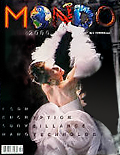
Zoning Out, Temporarily with Hakim Bey and Genesis P-Orridgeby John Perry Barlow, Mondo 2000 No. 9 1993


It was Queen Mu who made this happen - her conspiratorial whisper suggesting that I get myself together with Hakim Bey, Genesis P-Orridge, and a MONDO tape recorder. I wasn't too sure what she had in mind.

I mean, aside from the fact that all three of us are white, male acid-altered, old enough to know better, and crazy enough to do it anyway... Our resumes just didn't hook up and I wondered if we would.

Mr. Orridge, for example, is one singular fellow. He's got hardware dangling all over a body which sports more ritual scars and tattoos than Melville's Queequeg (with whom he shares other characteristics, most notably a nightmarish appearance cloaking a sweet and reasonable mind). He also happens to be the father of modern primitivism, the post-industrial tribes, the Rave Movement, the avant-garde band Psychic TV, and a couple of beautiful young daughters.

Orridge has been willfully causing such grave offense to British proprietary for the last twenty years that they've finally seen no alternative but to seize all his works and archives and pass laws which, though tailored to outlaw him, also make it a crime to give any other British subject so much as a hickey. (Or cause any physical harm to oneself or another consenting adult in the pursuit of dark pleasures.)

Finally, agents of the Crown have sent him packing into exile in California - a place so much more congenial to abominations that Mr. Orridge is having to scratch around for something to sink his sharpened teeth into.

Hakim Bey is another whose deviances have forced him to hide behind another name. Spending much of his life disguised as a mild-mannered comparative religion scholar, he emerges in print as an anarcho-gay drug fiend and Sufi pirate, compared to whom Salmon Rushdie is as orthodox as an ayatollah. Hakim's the guy who put the Temporary Autonomous Zone on the map.

However similar they might seem in their jointly unspeakable practices, their unabashedly unnatural acts, Bey and Orridge are quite different. Bey is reclusive and ascetic, a closeted natural philosopher, whereas Orridge is a performer, indeed something of a rock star.

And there's my own staid self, known to MONDO readers as a retired cattle rancher, rural gentlemen of such probity that, a couple years ago, I came within one vote of a Republican state senate seat in Wyoming, the most conservative part of the non-Islamic world. I'm a Freemason, a jack-Mormon, and a problem if I've been drinking. In short, just about everything these two are not.

And yet...

When, by virtue of a couple minor miracles, I was able to horse all three of us into my borrowed apartment in San Francisco's Potero Hill, a curiously complete zone of shared understanding arose between us. It felt as if we'd been opining around the same cracker barrel for years. During the hour and a half this field remained intact, we covered a vast stretch of philosophical country which the hacked and decimated thing below can only hint at.

-John Barlow

JOHN PERRY BARLOW: I want to talk with you guys about the Shadow. There is a way we have of concealing, projecting or wearing - in a peculiar fashion - that which we don't want to admit about ourselves. The thing that's interesting to me about you, Genesis, is that you look like an evil sonuvubitch from a distance. You look like a goddamn cannibal. And yet you are an extremely pleasant, polite, decent fellow.

GENESIS P-ORRIDGE: I think I look really West Coast.

HKIM BEY: I'm reading Hermes by Michel Sarres. And he brought up an interesting idea. He was talking precisely about this duality in Western culture... that there's always the on/off, dark/light, good/bad, up/down. He says that the third person is lost in Western discourse. Where any two are, there's a the third who has to be ignored. Apparently, he's going to suggest ways in which the third person can be re-integrated. Perhaps that's what we need, instead of paradox. He even calls it "the parasite" - the guest who gives words for food instead of food for food. The interlocutor... the third interlocutor.

GEN: Have you read The Third Mind by Brion Gysin? When he and William Burroughs came together and applied the cut-up method to their text, they produced a third mind.

HAKIM: ...as a parasite on that interaction! That's what Sarres is talking about.

GEN: I always found The Third Mind one of the most interesting subversive manuals. I never recommend the novels and stories of Burroughs or Gysin, I just say read The Third Mind and try some of those exercises. A lot of implications concerning inherited perception are revealed.

Scotland Yard has now got lots of videotapes that I made of Brion in Paris talking about psychic hygiene, the alchemical variations in the temperatures of boiling water, through the Master Musicians of Jajouka, all the events in Morocco that led him to many of his most intimate theories, even explaining how to make a good cup of tea by detailed observation of the bubbles, each of which he had named to denote each step. There's a lot of unique stuff there.

JOHN: I think they suppress that stuff mainly because they're afraid its reality could disturb what they wish to project about it. The image of Burroughs or you is so much easier to abuse. That's the scary thing about the information society - mythology completely detached from any reality but the one it's in the business of manufacturing. Pure simulation.

HAKIM: You know, the big difference between shamanic cultures and religious cultures is that dualistic shadow/anti-shadow thing is missing from shamanic culture. It was pre-Manichean, and now we're looking for something which is post-Manichean. Urban shamanism.

JOHN: I saw a very old Tantric Buddhist shrine near Kyoto. And the central icon of this place was a large sculpture of two dragons- one on the top with his tail coming up, and the other on the top, with his tail going down, entwining with the first dragon's tail around the middle. It reminded me of the Caduceus and its snakes, except that implied no value judgment between the upper and lower chakras. The point was the even interaction of the tails in the middle. So there was a duality, but it wasn't a weighted duality. It was more like a Yin/Yang.

HAKIM: No. The Yin/Yang theory is not Gnostic dualism. It's not the same thing. Eliade called it "dyadic." It's not the same as good and evil. It becomes so later in neo-Confucian thinking.

JOHN: Right, Taoism has no truck with good and evil at all.

HAKIM: Taoism seems to be the one religion that doesn't have the Gnostic trace.

JOHN: In our culture, the problem arose with the Romans.

HAKIM: I think it goes further back. It's Babylon. It's just like the Rastas say, "It happened in Babylon." It's Marduk and Tiamat. It's Mr. Hard-on God up against Sloppy Mom. In China, chaos is a benevolent property. Huntun is the gourd or the egg out of which everything comes. He's a wonton. Huntun and wonton are the same words. He's like this little dumpling and everything good comes out of him. In Babylon, chaos is the disgusting monster vagina that has to be ripped up by Marduk into myriad blobs of shit and slime. And we are those globs of slime. That's how the human race came into being. What is the purpose of the human race? To serve Marduk, to serve the masculine principle, to store up grain in the granary for the priests, to pay for the priests for their sacrifice so they get the free hamburgers. That's the whole Western myth. It's St. George and the Dragon. St. George pins the dragon down.

In China, the dragon is the free expression of creativity. He's the mixture of Yin and Yang, the principle of power. But here's evil, plain and simple. This is why chaos has kicked off, for me, for Ralph Abraham, and others, an interest in making a critique of this Western mythology, and saying, "Let's put Humpty Dumpty back together."

JOHN: There's been an interesting co-evolution lately of a lot of apparently disconnected things, like chaos mathematics and neo-tribalism, a sudden interest in Taoism and what I perceive to be a deep feminization of Western culture.

GEN: Some philosophers feel that there's a risk in absolute unconditional surrender of that male-God power, even though it's obviously failed miserably. Should we seek out every possible male trait and subordinate it to a female principle?

HAKIM: I didn't like the rule of Dad, but I don't think I'm going to like the rule of Mom either.

GEN: I'm involved with raves and live events because they're celebrations of an autonomous tribal unit. I think that was one of the real reasons for the attack on Psychic TV. It was the fact that we were doing unannounced, unadvertised, private parties where three thousand young people would aways turn up and bring one more friend next time. We were building this entire, separate, parallel vision - what Alaura calls "The Lost Tribe." We would discuss taboos, body modifications, self-empowerment, women's rights, animal rights, and all these different things as a spin-off. They weren't any of them essential in themselves. But what people always kept saying, over and over again, was that they felt they could relax and be themselves. The most obvious, ordinary condition that so very rarely happens.

JOHN: That's also why they go to Grateful Dead concerts. It's a sense of belonging which makes it possible for you to be yourself. When you're part of somethign on an organic level, then the self has some meaning. If you're only...

HAKIM: What about the problem of mediation? It sounds to me like you're less interested in media and more interested in the immediate, the un-mediated. A street concert is participator. It's got to be something you experience.

JOHN: Until McDonald's finds out about it and turns it into an ad.

GEN: Basically, the way you set your events up is the key to whether or not they're absorbed. And so far we haven't been absorbed. That's why we're being spat out. If your tension is not to sell yourself and your imagination, then there's a real problem with people in authority, because their normal debilitiser is the money carrot. They have a really patronizing view of the creative mind, that it really want to whore itself to them.

JOHN: Most commerce in this country is based on the unfulfilled psychic needs. The media have one message: "Eat this, drink that, wear this, put this on your body, do something about the horrible loathsome disconnected thing that you are."

HAKIM: The trick is that none of it works. It's what Walter Benjamin calls the "Utopian trace," which is built into those commodities that make you dream of the perfection that's being sold to you. But it's only a trace, like a trace element. It's like homeopathic; it's hardly even there. So, of course, it doesn't work.

JOHN: Recently I was on an NBC show about LSD. And they also had a self-described "recovering LSD addict." It was a real set-up. But I noticed that almost every ad was either for a drug or for something that would make everything somehow different. So the LSD which actually can make you different in a fundamental and satisfying way, represented the Demonic. LSD was the Shadow.

HAKIM: I read a quote from Malcom McLaren, where he said, "Why are drugs popular? I'll tell you. Because only drugs can make you feel like people in TV ads look like they're feeling." Drugs are the only commodity that's actually more than just a trace. It is - in some ways - the thing.

JOHN: It's close. And that makes it an enormous threat to the culture, which is base don unfulfillable need.

HAKIM: The best way to impose stability is through violence. Within every rational system is terror and death, unless you admit the third mind... the parasite. As long as linear reason calls the shots, it's always death and terror.

GEN: There's a great tape of Gyson, Gregory Corso, and Burroughs in Paris during the 50's. A letter arrives from some businessman in London, and you can actually hear Burroughs as he snips it with his scissors saying, "Now let's see what it really says." And then he reads it aloud and it basically goes, "... money... money ... money." I took that very much to heart. When in doubt, be extreme and see what it really says. There's a need for people to smash the shop windows because that debris can be reassembled into amazing things.

JOHN: There's a particular need when you've got a culture which has placed such an inordinate value on stability. We'll have to go some distance to re-assert the dynamic.

HAKIM: That's what's so useful about chaos and complex dynamical system analysis, which is now cutting edge. It's going to take a while. The popular discourse is still Cartesian.

So what's the social anti-spasmodic for the spasms we've been talking about? Again, what about... tactics?

JOHN: The best anti-spasmodic is a joke. Take a leaf from Catastrophe Theory, which is really the science of the punch line. IT's the thing that suddenly takes you out of the locks system and helps you go meta.

There's a great Neal Cassady story about this. The PRanksters all went into a bar in Oakland after a rally in Berkeley, and everybody was high on acid. It turned out to be the wrong kind of bar. Basically, there was a group of guys about to pretty much disembowel someone. But it was a perfectly symmetrical situation with nowhere for things to go but bad. Cassady strutted over to the assailant group, and said, "Hey, anybody want some gum?" And this was the catastrophe that caused the whole thing to dematerialize. For these locked symmetries, the most powerful cure is the prank.

HAKIM: That's an interesting way of looking at it. Poetic terrorism. Pirate humor.

GEN: That's why Dada and surrealism and happenings and acid and cut-ups are actually tools of survival.

HAKIM: They're anti-spasmodics.

GEN: It's really empowering when you break up or collage stuff together, bring in the unexpected or the inappropriate. Those who are trying to impose the status quo and a linear view can't read that language.

JOHN: It's too ambiguous for neurotics.

GEN: They're unable to deal with the anarchic, confused, colliding, or absolutely illogical combinations. Tim Leary believes that's what is really behind the attacks on us. What SCotland Yard is actually attacking is my archive. For over 25 years I've collected things that don't fit together. I've got Dada stuff, Fluxus stuff, Brion Gysin's stuff, Burroughs' stuff, Leary's stuff... psychedelic, tragic, radical, trivial, random, and mathematical stuff. And we have no "agenda," as they like to say these days.

We've followed the logical path. One day we just sold a spare Austin Osman painting to Chris Stein [of Blondie] and left. We spent time in Thailand, then we went to Nepal. Nepal was an amplifier and the confirmation of so many threads we have been unraveling and following for so much of our lives. The basic premise being AGORI... the path of no distinction. In this, everything is equal. There is on Shadow. All aspects of life and death, the minute to grandiose scales are fully integrated. Thus, no comment upon this amazing state of affairs is necessary. The most fabulous is commonplace. Devotion is as ordinary as taking a breath... and, of course, as extraordinary. We'd leave the hotel and cross the river, and there'd be dead dogs floating in sacks, or lodged in the mud banks with huge pigs eating their remains. There'd be children's corpses being cremated on the burning chats, their ashes swept into the same river while, further downstream, women were washing their cooking pots. Next to the burning children, there'd be workers eating breakfast, lepers begging, tourists taking pictures, Hindus prostrate... all in devotion , all simply living...

That's where we were just as we were being attacked in England. And thus we were better able to deal with the attack and its ramifications. We were able to say, "So what?" I mean, here were the Tibetans dealing with genocide. They've lost everything and yet they were embracing us without asking "Who are you, what do you believe, what do you do...?" There was a deeper sense of connection and recognition that instantly allowed us all to converse and be together. No justification was necessary. Ah, blessed relief! In the same way, the Shiva saddhus, the Nagas and the Agoria Baba... all highly evolved, threshold pushing, ascetic strands of Hinduism that believe in the "Path of No Distinction" ... they welcomed us too. We were on a bridge at Pashapati, near the main burning ghats, when suddenly the most revered holy man of the Agori was standing by us in his dreadlocks, and took us into his chamber where Europeans are not ordinarily allowed. There we sat around a fire which hasn't gone out once in over a thousand years. We exchanged spontaneous gifts, suspended Western categories of thought, and absorbed the peace of primal vision. To be trusted is such a fabulous gift, even greater when one is given that trust under no obligation. The Agori Baba gave us a white ash form the thousand-year-old-fire, "to take with you to bless America" he said.

Strength. We've kept that strength through everything that's happened since then. It's very reassuring, an embrace in a realm beyond thought or sense. It is this momentary experience of "belonging" that is carrying us through; this basic task of navigating through the unexpected conjoining and juxtaposition, grappling with the grinding together of things is like learning a martial art. To bend, flow, parry, using the strengths and rushes as our own muscles.

That's the first step, getting these survival tools. Then the game is: do we finally evolve, or not? I talk about a human(e) race where the extra "e" is added to suggest ecstasy, eager, evolutionary, evil, experiential, egolessness, etc. In other words, whatever happens next. Above all else, a risk-taking explosion with the eeego tacked onto this story. We are each there within this mystery. We're at a point where there's going to be an evolution away from the previous static system into the embracing of chaos.

HAKIM: I don't think that we're evolving towards anything, in the Teilhard de Chardin sense of evolution being directed toward the collective organism of human mind. I have a lot of problems with that. But if you start to look at the way the world is going: political - you have a fragmentation of structure that is devolving down to smaller and smaller discrete communities at the same time that there's a globalization going on, then you can start to think of the paradoxical interaction of the global mind, the "all mind," becoming an increasingly coherent unity, even as individuation is becoming more profound. That seems hopeful, to me.

The problem is looking at it as an Omega Point. It's still teleological. And not only that, it's unjust. Because if Paleolithic human and medieval human and modern human are excluded from that Omega Point, then God is even a worse sonuvabith than we suspected. That's what I've always objected to in Teilhard, and that's the problem I have with the idea of an evolution. I can't see it as an evolution. I see it as an infolding. Change. This is why I've tried to develop the idea of the Temporary Autonomous Zone. Because I'm sick and fucking tired of waiting for the revolution or the evolution. A certain degree of selfishness is required. And that selfifshness also involves an altruism, because what I want for myself obviously must be available to the other.

I want to get away from the Newtonian force and talk about the power in a fractal design. It's not teleological, nor vitalistic. It's not pointing to the future. It's not pointing to the past. Ilya Prigogine talks about "creative evolution," which to me is an infolding. It doesn't fold itself out towards the future, but it infolds itself towards desire.

JOHN: The basin of attraction.

HAKIM: The basin of attraction is the infolding of desire.

GEN: Basically, if what you're doing is dragging people across the line of what they'll accept, then it's endorseable. It was actually Tim Poston, my catastrophe theory friend, who gave me direction in this area. We did a magazine together called Delusions of Grandeur in the 60's. The original slogan was "The Possibilities Alone are Endless." As he pointed out, the "The Impossibilities are Endless" too, as are all those phenomena which are neither possible nor impossible. The addenda are implied, not necessarily alluded to. There is a geological term I was made aware of later by a kinetic artist named Gerald Fitzgerald. (He was a prime mover in the Exploding Galaxy fluxus and happening group at the time, along with Derek Jarman and myself.) The term is quaquaversal, which means "pointing in every direction simultaneously."

JOHN: The challenge, at this point, is learning to read the tea leaves in such a fashion that your interpretive assumptions bear some relationship to the next person's. So your society doesn't just dissolve into babble; so you're not isolated by everybody's unique magical universe. One approach might be the ritualization and the re-tribalization of society. The point isn't that we agree. The point is that we all dance.

HAKIM: Nietzche said that if we want to be a dancing star, we must have chaos within us. So, already in the 1880's, this concept was out there.

JOHN: Well, it was out there long before Nietzsche. Don't forget Shiva.

GEN: That's one of the most rejuvenating things about traveling in the Far East. There's a deep sense of continuity, a time-depth to the exploration.

HAKIM: It's only a very small time we've had history. It's useful to think of history as this thin layer of slime over a huge sea of the Paleolithic. It's not a question of a return to the Paleolithic but a return of the Paleolithic.

GEN: Now we really don't even belong to Her Majesty. We were subject. Theoretically, we were actually owned by Her Majesty.

HAKIM: Along with the swans and Scottish Deerhounds.

GEN: I'm basically on the run and feeling good about it. The Global Village definitely seems to be forming. We're commuting to Japan. The Japanese are commuting here. Computer terminals and modems are linking people up. In all this action forms the wraith-like Global Village. There seem to be a lot more doors and windows left open than there were a few years ago.

On the good days - which are many - we think about sending postcards to D.C. Yeoull at Scotland Yard. Pictures of us on the beach in Thailand or giving rice and dal to lepers in Kathmandu, or onstage with Timothy Leary, or sitting by a fire here in California with our creek in the background. We think of saying, "D.C. Yeoull! Thank you very much for your interest in our work, and more importantly, for letting us go free so we can finally travel this world and do so much more of it!"

HAKIM: Jesse Helms deserves a few letters like that too.

GEN: Did I tell you what Yeoull said when some friends of mine went and tried to demand our archive back? He said, "My job, as I see it, is to rid the world once and for all of this art scum." [laughter]

There's a lot to be said for the fanatic on your tail.

HAKIM: A good enemy is hard to find in this wishy-washy world of ours.

Friday, June 18, 2010

CHOAS > ORDER

"Chaos comes before all principles of order & entropy, it's neither a god nor a maggot, its idiotic desires encompass & define every possible choreography, all meaningless aethers & phlogistons: its masks are crystallizations of its own facelessness, like clouds. "

From T.A.Z. ("The Temporary Autonomous Zone") by Hakim Bey

(click the know more about the book)
 

Monday, April 5, 2010

POLITICS AND RAVING

 
Date: Thu, 30 Mar 1995 12:39:55 -0800 (PST)
Subject: Politics and Raving

While I'm all in favor of people getting involved with trying to influence the "system", I see the role of raving mainly as a promoter of individual mental and spiritual health. If Rave(tm) becomes a sociopolitical movement engaging itself with the world's obvious problems, then it will become part of the current system which is designed to incorporate and absorb such forces, no matter how progressive or revolutionary they may seem.

I really have to disagree. first, raving can be seen as a promoter of COLLECTIVE
mental and spiritual health, which is in itself political, oppositional to a
system based on greed and consumption and with no real understanding of "health."
further, i see raves as TAZs (Temporary Autonomous Zones), where we can practice living as if we are free. i see freedom (the anarchist revolution big techno
potluck shindig!) as a PROCESS, again, where we learn to live and take care of
ourselves as if we are free, in a world we imagine (free of sexism, racism,
heterosexism ... all forms of authoritarian repression). when we organize
parties collectively we learn how work can be done without hierarchies.

in addition, gathering together to create healthy communities in a culture that
seeks to divide us, or give us a false sense of community based on mtv and
consumption, is a radical and political act. creating art and play outside of
the marketplace (renegades and benefits) is a radical and poltical act.

further, raves can be a place where we share information - on health,
spirituality, political and social movements and ideas ... and of course we can
fundraise, which is CLEARLY and example of "rave...engaging itself with the
world's most obvious problems."

every time i rave, i voice my protest against "the system" (who says protests
have to be covered by the mass media-demons?) every minute i spend organizing
parties with a purpose is my protest against a system that sees play either as
superfluous, or as a "leisure-time hobby." NO - raving, right now, gives me LIFE.
work just pays the rent and puts food on the table (and tries to suck all my
life-energy out of me - sigh.)

of course, i'll continue to do the "regular" kind of political work (voting,
marching, letter-writing...)...NOT because i believe this is the way to freedom,
but because we'll get trampled all over if we don't!

so there's my rant for the day. and since we've been making book recommendations
lately, i have to add Hakim Bey's TAZ and IMMEDIATISM (if you try to ignore his
anti-abortion gibberish in TAZ). as well as Starhawk's TRUTH OR DARE.

take care everyone,
monicat
 
"We will build the new society in the shell of the old" - IWW 

Wednesday, February 17, 2010

TIJDELIJKE AUTONOME ZONE AUTONOME TEMPORAIRE

Since not everyone is able to read and comprehend everything they read in English. That is why figured it would be interesting for some of our readers to read The Temporary Autonomous Zone by Hakim Bey in their native language.


"Zijn wij gedoemd om nooit autonomie mee te maken, nooit zelfs maar een moment lang op een uitsluitend door vrijheid geregeerde bodem te staan? Moeten we wachten tot de hele wereld bevrijd is van politieke overheersing voordat één van ons weet wat vrijheid is?

...

"De TAZ is een perfecte tactiek voor een tijdperk waarin de staat alomtegenwoordig is en tegelijkertijd vergeven van de barsten en lege ruimten. De TAZ is de opstand binnen ieders bereik, het feest dat elk moment kan losbarsten. Ze verlangt er bovenal naar bemiddeling door media te vermijden, haar bestaan als immediaat te beleven. Omdat de TAZ een microkosmos is van de 'anarchistische droom' van een vrije cultuur, kan ik me geen betere tactiek voorstellen om naar dat doel te werken en tegelijk al hier en nu wat van de voordelen ervan te beleven."
"Babylon ziet haar abstracties voor realiteiten aan: precies binnen deze vergissingsmarge kan de TAZ ontstaan. De TAZ op gang brengen kan inhouden dat er gewelds- en verdedigingstactieken worden gebruikt, maar haar grootste kracht ligt in haar onzichtbaarheid -- de staat kan haar niet herkennen omdat de geschiedenis haar niet kan definiëren. Zodra de TAZ wordt benoemd (vertegenwoordigd, bemiddeld), moet ze verdwijnen, zal ze verdwijnen en slechts een leeg omhulsel achterlaten, enkel om ergens anders weer op te duiken, eens te meer onzichtbaar want ondefiniëerbaar in termen van het spektakel. Zo is de TAZ een perfecte tactiek voor een tijdperk waarin de staat alomtegenwoordig en oppermachtig is en tegelijkertijd vergeven van de barsten en lege ruimten. Omdat de TAZ een microkosmos is van de 'anarchistische droom' van een vrije cultuur, kan ik me geen betere tactiek voorstellen om naar dat doel te werken en tegelijk al hier en nu wat van de voordelen ervan te beleven."

Intresse?


Zone Autonome Temporaire (cliquez sur l'image pour telecharger le PDF)

"La TAZ (Temporary Autonomous Zone), ou Zone Autonome Temporaire, ne se définit pas. Des "Utopies pirates" du XVIIIe au réseau planétaire du XXIe siècle, elle se manifeste à qui sait la voir, "apparaissant-disparaissant" pour mieux échapper aux Arpenteurs de l'Etat. Elle occupe provisoirement un territoire, dans l'espace, le temps ou l'imaginaire, et se dissout dès lors qu'il est répertorié. La TAZ fuit les TAZs affichées, les espaces "concédés" à la liberté : elle prend d'assaut, et retourne à l'invisible. Elle est une "insurrection" hors le Temps et l'Histoire, une tactique de la disparition. Le terme s'est répandu dans les milieux internationaux de la "cyber-culture", au point de passer dans le langage courant, avec son lot obligé de méprises et de contresens.
La TAZ ne peut exister qu'en préservant un certain anonymat ; comme son auteur, Hakim Bey, dont les articles "apparaissent" ici et là, libres de droits, sous forme de livre ou sur le Net, mouvants, contradictoires, mais pointant toujours quelques routes pour les caravanes de la pensée.
"

"... nous ne cherchons pas à vendre la TAZ comme une fin exclusive en soi, qui remplacerait toutes les autres formes d'organisation, de tactiques et d'objectifs. Nous la recommandons parce qu'elle peut apporter une amélioration propre au soulèvement, sans nécessairement mener à la violence et au martyre. La TAZ est comme une insurrection sans engagement direct contre l'État, une opération de guérilla qui libère une zone (de terrain, de temps, d'imagination) puis se dissout, avant que l'État ne l'écrase, pour se reformer ailleurs dans le temps ou l'espace. Puisque l'État est davantage concerné par la Simulation que par la substance, la TAZ peut "occuper" ces zones clandestinement et poursuivre en paix relative ses objectifs festifs pendant un certain temps. Certaines petites TAZs ont peut-être duré des vies entières, parce qu'elles passaient inaperçues, comme des enclaves rurales Hillbillies - parce qu'elles n'ont jamais croisé le champ du Spectacle, qu'elles ne se sont jamais risquées hors de cette vie réelle qui reste invisible aux agents de la Simulation."

Ou "zones autonomes temporaires", un essai de Hakim Bey.

Sunday, January 10, 2010

AKASHIC RECORD OF THE ASTRAL CONVENTION


In 1987 Hakim Bey invited several friends and allies to astrally project to Antarctica for a convention. Afterwords, visitors sent their accounts to Bey and he compiled them into this zine. The Akashic Record of the Astral Convention. This collection was originally sent only to the contributors and has never before been reprinted. It features lost works by: Coil, Hakim Bey, Shirley MacLaine, James Koehnline, Ivan Stang, Feral Faun (aka Apio), Reverand Crowbar (aka Susan Poe) and Trevor Blake.


INTRODUCTION (excerpt from the zine)

This is the record of the AAAZ, the Antarctic Astral Autonomous Zone, that occurred on the night of August 31st - September 1st, 1987.

Hakim Bey is the author of Temporary Autonomous Zone. It's a cultural milestone for a wide variety of subversives from anarchists, occultists, vandal artists, and freaky festival people. The main idea of TAZ was to create exactly what it sounds like TAZ is about: creating places that serve as alternative realities to the prevailing system of control. Specific times and spaces designated to let chaos free, and allow psychological and social mechanisms to self regulate and mutate beyond the confines of so-called consensus reality.

The focus is on having individuals find and establish meaning on their own terms. Creating a TAZ requires face to face interaction and dialog, in a sense, creating an art form which is impossible to ever fully record or understand. In the void where stagnancy and boredom once ruled, wild fantasies called real life take root. The elusive genuine article, with no possible televised reenactments.

Before TAZ's thought virus would reach the anti-capitalists and the rave scene as it did in the 90's, many of the people who recognized the value of Bey's work were few and far apart. Mail order culture was the primary mode of communication with the underground for many people in the 80's. The postal world seen within the pages of High Weirdness by Mail by Ivan Stang has now mostly migrated to cyberspace, where many of these fringe cultures have exploded into bonafide phenomenas. In the meantime, the mutants who were plugged into the paper trail of fresh ideas were yearning for an opportunity to encounter a TAZ. This meant finding a 'Zone' which was totally unexpected.

It was decided to meet astrally or in dreams, at a specific sacred space in Antarctica. Bey sent invites out to his network, and arranged for everyone who participated to send him their experiences, which he would then compile and send back out. What you end up with is an compilation of rare works by an all-star cast of individuals who comprised the occulture before there was a word for it. In this instance, the media created here facilitated a syncing up of communal experiences, and was an essential component of the AAAZ, yet not the AAAZ in itself.

The objective reality of astral projection is inconsequential to the AAAZ. What is of importance is the narrative, lives encouraged to be lived mythically, drawing those lives together in the process. Then again, for those who do entertain astral experiences as accepted facets of reality, the AAAZ was most likely one of the earliest documented records of shared lucid dreams and consciousness. It is historically important for occultists, and personally fulfilling for those who got to participate in it.


Thursday, May 7, 2009

Hakim Bey and Ontological Anarchy

For all I know the Bilderberg Group runs our planet. 
Or better.. they decide how it is being run and our society is too ignorant to be aware of it. There isn't anything I can do other than spreading the word. But that is something I will get back to later.
What I can do is living my life in a way I want to.
A major part of that is the free spirit. 
Not being a frequent reader myself I do have some literature that has had a great impact on the way I think and my look on the world.
The writings of Hakim Bey have been a great influence in my life for a long while now. Especially Temporary Autonomous Zone and Millennium are a must read for those interested in the land of the free.
His writings can be freely pirated (copyright who?) so you can find numerous copies of his word magic online. A great collection can be found at the Hermetic Library.
- Temporary Autonomous Zone
- Millennium

"What of the anarchist dream, the Stateless state, the Commune, the autonomous zone with duration, a free society, a free culture? Are we to abandon that hope in return for some existentialist acte gratuit? The point is not to change consciousness but to change the world."